
The biggest reason garage sales fail has nothing to do with the weather or the location. It is unpriced items. A shopper who cannot see a number will not stop and ask, because asking feels like an imposition, so they walk past your table and end up buying the same three things everyone else has priced.
Get the numbers right and the rest of the sale takes care of itself. The right numbers are not complicated. They come down to a small set of rules you can apply in an evening, before you ever put a sign out.
How to price garage sale items, in short: work out what you originally paid or what it would cost to replace the item, then start at roughly 10 to 30 percent of that figure depending on condition and demand. Adjust by the condition tiers below, round the result to a clean number a buyer can hand you without hunting for coins, and write it on the item before the sale starts. Everything else in this guide is detail on those three moves.
Throughout here I have used Canadian dollars, because that is what the money in my hand is. The percentages are currency-neutral, so the rules transfer to any market, but the category price list reflects what Edmonton and Northern Alberta thrift counters and resale apps actually transact at.
Table of Contents
- How to Price Garage Sale Items: The Garage Sale Pricing Rules
- Garage Sale Price List: What to Charge by Category
- How to Mark Your Prices So Nobody Has to Ask
- Bundle, Bulk, and Or Best Offer Pricing
- How to Adjust Prices During the Sale
- How to Handle Haggling Without Losing Money
- What Sells Best and What Sits Until Teardown
- What Not to Sell at a Garage Sale
- Best Days, Times, and Where to Hold Your Sale
- Advertising and Signage That Bring Buyers
- Items Worth Researching Before You Price Them
- Cash, Coins, and Payment Logistics
- Your Two-Month Garage Sale Timeline
- What a Successful Sale Actually Earns
- Frequently Asked Questions
- How should I price things for a garage sale?
- How do you price things for a garage sale this year?
- What is the best way to mark items for a garage sale?
- Is it okay to price everything in whole dollars?
- What does not sell well at garage sales?
- What items sell best at a garage sale?
- What are the biggest yard sale mistakes?
- What are some tips and tricks for sellers at a yard sale?
- How much should I charge for power tools at a garage sale?
- What not to sell at a garage sale?
- Conclusion
How to Price Garage Sale Items: The Garage Sale Pricing Rules
Shoppers at a yard sale are not comparing your item to a retail listing. They are comparing it to the thrift store they will drive past on the way home, and to the general feeling that a driveway is a bargain bin. Price inside that expectation and the item moves. Price like a boutique and you will pack it back into the box it came from.
Rule 1: Start at 10 percent of the original purchase price
This is the 10% Rule, and it is the single most useful number in garage sale pricing. An item you paid 60 dollars for at full price is a 6 dollar item at your sale. A jacket you paid 120 dollars for is a 12 dollar item. Sellers on Reddit consistently report that buyers at a multi-family sale compare prices against each other, so a table that looks internally consistent builds trust for the whole sale.
Rule 2: Use the 10-30 percent range, not a single number
Flat 10 percent will leave money on the table for the things people actually drive across town for. The 10-30% Rule widens your starting band: low-demand, common household goods sit near the bottom, while sought-after categories sit nearer the top. One senior Alberta seller described the range as the difference between clearing a basement and getting a fair return for the effort.
Rule 3: Let condition set your tier
This is where most first-time sellers go wrong, because they price by what the item meant to them rather than what condition it is in today. Here is the tier breakdown we use, and it is the same framing the strongest pricing guides on this topic use.
| Condition tier | Share of original retail or replacement cost | Typical examples |
|---|---|---|
| Worn, stained, missing parts, needs repair | 1 to 3 percent | Outgrown kids’ shirts, tired area rugs, broken small appliances |
| Used, works fine, shows normal wear | 5 to 10 percent | Most used books, everyday clothing, standard housewares, board games |
| Good, clean, minimal signs of use | 10 to 20 percent | Tools with light wear, name-brand casual clothing, complete kitchen sets |
| Like new, barely used, tags still attached | 25 to 35 percent | Outgrown baby gear, formal wear, opened-but-unused boxed items |
| Scarce, hard to replace, works perfectly | 50 to 60 percent | Good power tools, camping gear, professional kitchen equipment |
| Boxed and never opened, hard to find | 60 to 70 percent | Limited-run collectibles, discontinued models, current electronics |
Notice the jump between the third and fourth rows. A barely used item is not worth 10 percent more than a used one, it is worth two to three times as much. Sellers who treat the tiers as one continuous scale consistently underprice their best stuff.
Rule 4: Round to clean numbers, and avoid pennies entirely
Your price list should contain no 5, 9, or 19 cent endings. Shoppers who need to hand you four coins for a 3.78 dollar item will either round up and resent it, or put the item down. The recurring question on selling forums is whether everything should be in whole dollars, and the answer from experienced sellers is yes, in even dollars, because a sale runs on speed and nobody wants to break a 20 for a 7 dollar item.
Rule 5: Price every single item, no exceptions
Anything unmarked is treated as a donation, because shoppers assume that is what it is. If you genuinely do not want a number on an item, mark it clearly as free or as a fixed-price bin, and do not leave it ambiguous.
Which pricing method should you use?
There are four workable approaches. They are not equally good for every category, and mixing them is usually the strongest play.
| Method | What it is | Best used for | Weak point |
|---|---|---|---|
| 10% Rule | One tenth of the original purchase price | General household goods, clothes, kitchen items | Underprices scarce and like-new items |
| 10-30% Rule | A band from 10 to 30 percent by condition and demand | Almost everything, used as your default | Requires a decision on every item |
| Colour-dot bins | A small set of price points, each with a coloured sticker and a posted key chart | Large sales, high-volume clothing and books | Items do not fit neatly into five prices |
| Bundles and bins | Multi-item lots at a set price, such as six for five dollars | Clearance at teardown, leftovers, small items | Needs volume to look like a deal |
Garage Sale Price List: What to Charge by Category
Below is the reference list I work from. Prices are in Canadian dollars and assume average used condition, so adjust up a tier for like-new items and down a tier for worn ones. Treat it as a starting point rather than a verdict, and check what the same category costs at your local thrift stores, because regional cost of living changes what buyers consider fair.
| Item | Typical price (CAD) | Quick note |
|---|---|---|
| Hardcover novels | 2 to 5 | Common titles at the low end, signed or first editions higher |
| Paperbacks | 1 to 3 | Bundle by the shelf |
| Textbooks | 5 to 20 | Post secondary textbooks move fastest before classes start |
| Cookbooks | 2 to 8 | Vintage and regional titles do well |
| Children’s picture books | 1 to 4 | Bundle ten for five dollars |
| Board games | 5 to 15 | Check that all pieces are present, complete sets sell much faster |
| Video games | 5 to 20 | Test the console disc before the sale |
| DVDs and CDs | 1 to 5 | Bin by genre, never price individually |
| Vinyl records | 2 to 10 | Common pressings near 2 dollars, collectible pressings far higher |
| Men’s casual clothing | 3 to 10 | Name brands at the top of the range |
| Women’s casual clothing | 3 to 12 | Designer labels justify research first |
| Kids’ clothing | 1 to 5 | Size does not matter, shoppers will sort through it |
| Baby clothing | 1 to 3 | Outgrown sizes clear fast |
| Winter coats | 10 to 30 | Season timing matters more than the tier |
| Work uniforms and safety gear | 10 to 25 | Check size and condition carefully |
| Designer handbags | 40 to 150 | Research before pricing, see the section below |
| Shoes | 2 to 10 | Pair them and note the size on the tag |
| Small kitchen appliances | 3 to 12 | Working and clean, so plug it in for them |
| Good cookware and pots | 10 to 30 | Brand name carries the price here |
| Kitchen gadgets and utensils | 1 to 5 | Dollar bin material |
| Dinnerware sets | 10 to 25 | Count pieces and photograph for the listing |
| Bedding and linens | 3 to 12 | Clean and folded reads better than folded and dusty |
| Towels and curtains | 1 to 5 | Bundle them |
| Hand tools | 2 to 8 | Worn handles lower the price |
| Power tools, good condition | 25 to 80 | Include the battery and charger, buyers ask |
| Lawn and garden equipment | 20 to 75 | Seasoned categories sell hardest in spring |
| Exercise equipment | 15 to 60 | Large and heavy, expect a lowball |
| Bicycles | 25 to 90 | Working brakes add real value |
| Small electronics and cables | 2 to 15 | Test everything before labelling it |
| Games and toys, boxed | 5 to 20 | Complete sets only |
| Building blocks and sets | 10 to 40 | Missing pieces cut the price sharply |
| Baby gear and equipment | 10 to 35 | Skip car seats and anything recalled |
| Books on shelves, per shelf | 5 to 15 | Label the shelf, not the books |
| Area rugs | 10 to 40 | Roll them up to save table space |
| Small tables and stools | 10 to 30 | Good first-hour items, buyers come for them |
| Chairs, dining | 10 to 25 | Set of four sells as a set |
| Desks | 25 to 75 | Measure it, serious buyers will |
| Dressers and chests of drawers | 40 to 120 | Refinish scuffs beforehand, it moves pieces faster |
| Mattresses, queen or larger | 30 to 80 | Not a sold item, be honest about condition |
| Sofas and armchairs | 50 to 150 | Advertise these early, they need a truck |
| Collectible figurines and cards | 5 to 60 | Research sold listings before you commit |
| Vintage cameras and audio gear | 20 to 70 | Test if it works, say so either way |
| Christmas and seasonal decor | 2 to 20 | Off-season sales for this category do not work |
| Potted plants | 2 to 15 | Local buyers only, do not ship plants |
Two things are missing from most published price lists and matter here. First, regional cost of living, which is why checking your local thrift counters before you price is worth one evening. Second, the gap between what the item cost you and what it cost new, which is why the 10% Rule beats your own memory of the price.
How to Mark Your Prices So Nobody Has to Ask
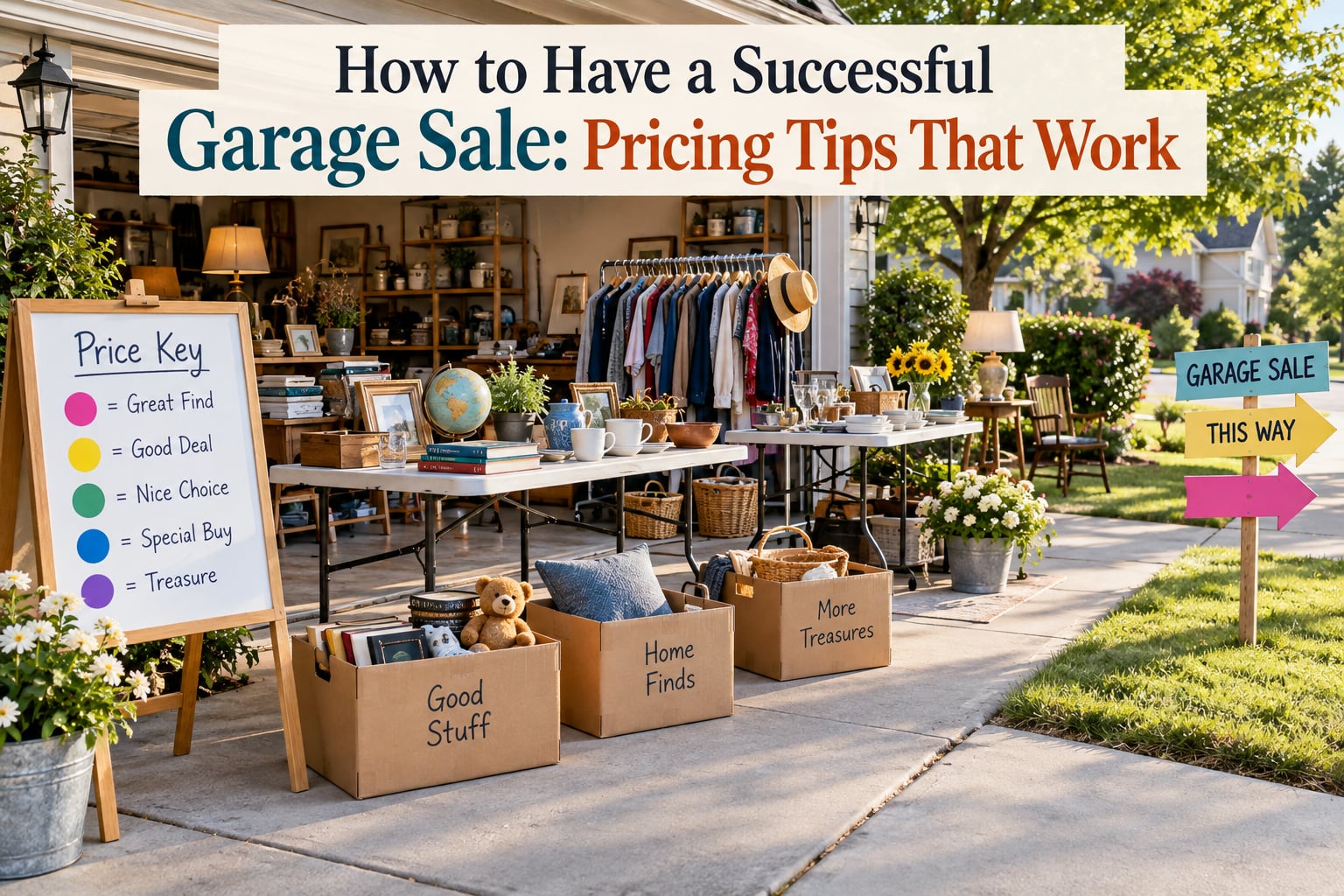
The best way to mark garage sale items is with a small set of colour-coded dot stickers plus one posted key chart, and to put a sticker on literally everything. A seller on r/Frugal described the coloured dot system as the compromise that finally ended the debate between pricing everything and leaving bins to negotiation, and that matches what we see in practice.
Here is how the system works. Pick four or five price points, for example 1, 2, 5, 10 and 25 dollars, and assign each one a colour. Write the key on a piece of poster board, pin it where people enter, and stick the matching dot on every item. A shopper reads the chart once and then self-serves the entire sale, which means they pick up more than they planned to buy and stop bothering you at the cash table.
Four details make the difference between a system that works and one that annoys people. Put the dot on the item itself, not on a sign beside it, because signs get moved. Keep the key chart large and at eye level. Use one price for all similar items, so twenty identical shirts are not twenty different numbers. And remove every sticker, tag and chalk mark carried over from a previous sale, because a faded old sticker is worse than no sticker at all.
If you would rather not buy dot stickers, masking tape and a marker work just as well, and a heavy marker on a white sticker survives a drizzle. What does not work is a small sticky note on the underside of an item, because nobody crouches.
Bundle, Bulk, and Or Best Offer Pricing
Bundling is how you move volume without moving your price floor. The standard rates that work in almost any market are two for one dollar for small loose items, five for two dollars, six for five dollars, and ten for five dollars for books and mixed small goods. Flippers use the same math when they are moving a table of odds and ends, and add a dollar-each or per-lot price once an item has sat all morning.
Bins built around a single price pull shoppers in and stop them from haggling. A one dollar bin and a two dollar bin placed at the entrance does more work than a sign advertising fifty percent off, because the bins are the discount. Put the least valuable items in the most visible position, because a buyer who takes a 1 dollar bin is now carrying your table around with them.
Or best offer pricing is the exception, not the default. It works on large furniture, on items you researched and priced high, and on anything you would rather donate than repack. It fails on small items and on anything you want gone, because every conversation costs you about ninety seconds, and a lowball in front of a line of shoppers is hard to refuse politely.
How to Adjust Prices During the Sale
Start high and cut in predictable steps. Sellers on r/Frugal describe the pattern most sellers land on: higher prices in the first hour, steady reductions through the middle, and a final sweep near the end.
- Before opening: every item carries its opening price, with no haggling. This is the only price most shoppers will ever pay.
- First hour: hold. If you want to reward early shoppers, cut one or two headline items by a quarter at 8am, which creates a small rush and gives you a reason to stop arguing about the rest.
- Late morning: anything that has had five or more people look at it and nobody pick up gets 20 percent off. Move it to the markdown table and take the stickers off.
- Final hour: everything remaining is a two dollar bin, or a dollar bin, or free. Decide the cut-off in advance and stick to it, because the temptation to keep one item at full price is what leaves you repacking boxes at 6pm.
Write the markdown rule on your key chart so shoppers see it coming and plan their purchase earlier. Sellers who post an afternoon markdown time get browsers at 11am instead of at 4pm, and it moves more.
How to Handle Haggling Without Losing Money
Set the sticker price about 10 percent above the number you will accept, so you have room to concede without going under your floor. A homeowner commenter put it plainly: ask 10 percent more than your bottom dollar on the larger things, and do the haggling on those items only.
Three habits keep it civil. Negotiate in front of other shoppers, because competition for a bargain is the best price support there is, and it makes an aggressive offer look silly. Give one concession, not a conversation, and pair it with something that costs you nothing, such as throwing in a bag of the dollar bin. And never negotiate with someone who has not yet committed to a purchase.
On payment, take the money before the item leaves your hands. Sellers on r/homeowners raised the same point: if you accept an e-transfer, a cheque or anything that has to clear, the item is still yours until it does. Cards and phone taps are worth accepting, but know the fee, and keep a box of coins for the change requests that will absolutely happen.
What Sells Best and What Sits Until Teardown
Knowing what moves is worth more than any pricing tweak. These are the categories that reliably sell in the first two hours, and every one of them is cheap, useful and easy for a stranger to judge.
- Books and textbooks, especially post secondary
- Board games and complete toy sets with all pieces
- Small kitchen appliances that plug in and work
- Tools, hand tools especially
- Children’s clothing outgrown in the last year
- Bikes and sports equipment in season
- Bedding, towels and kitchen linens
- Baskets, bins and storage containers
Now the honest list. These are the items that sit from 8am to 6pm and come home with you, and the reason is usually demand rather than price.
- Broken or incomplete items, because nobody wants to solve another person’s project
- Out-of-season items, so winter coats in June and patio gear in January
- Common furniture with no story, since four identical tables are all priced the same and only one sells
- Clothes that are stained, faded or missing buttons, whatever the sticker says
- Expired pantry items and anything homemade, which buyers cannot verify
- Old electronics with no charger and no working demonstration
- Very large or heavy pieces, because the buyer needs a truck today
If an item is in that second list, the fix is usually not a lower price. It is a bundle, a smaller size, or a decision before the sale not to bring it out at all.
What Not to Sell at a Garage Sale
Some items should not go out the door at any price, because the risk sits with you after the money changes hands.
- Car seats and booster seats. These have expiry dates and recall history, and you cannot pass on the history honestly. Most sellers simply give them away or drop them, and that is the right call.
- Bike and sports helmets. Impact history is invisible and the liability is not.
- Recalled products. Check Health Canada recalls before the sale and pull anything on the list.
- Cribs, cradles and drop-sided cribs that do not meet current safety rules.
- Untested electrical items, cords and heaters. Plug them in, or do not sell them.
- Opened cosmetics, vitamins and anything with a seal you broke. You cannot vouch for how it was stored.
- Food, home baking and homemade preserves. Provincial rules cover this and liability insurance rarely does.
- Prescription medication and anything a buyer must sign for. Leave those out entirely.
Two Canadian-specific notes. Small appliances need to be clean and working, and if you test them in front of a buyer, do it on your own outdoor power, not a shared one. And if you are selling anything with a cord, a battery or a heating element, being upfront about its condition in writing protects you when the buyer argues at 9am on day two.
Best Days, Times, and Where to Hold Your Sale
Traffic follows convenience. Friday evening and Saturday morning carry the heaviest foot traffic, and the first hour of Saturday is when the pickers show up. Start at 7:30 or 8am. Starting later means you lose the early crowd and finish with an afternoon of leftovers.
Friday and Saturday mornings between 7 and 10am are the four hours that decide your day. After 10am on Sunday, you are pricing for donation, not for income.
For Edmonton and Northern Alberta, the calendar matters more than in milder markets. The workable windows are late May through early July and late August through the end of September, when mornings are cool and afternoons are not yet cold and wet. Skip a weekend with rain in the forecast. A light drizzle loses you about half your crowd and leaves you holding damp boxes.
Location rules are worth checking in your municipality before you post anything. Some cities require a permit for a temporary sign on a public right of way, and some neighbourhoods have covenants that restrict signage. A quick check costs you nothing compared with a complaint on sale morning.
Advertising and Signage That Bring Buyers
A sign does one job, and it is not decoration. It needs three things to work: the word SALE at a size visible from across the street, the date, and the time window. Missing any one of the three is the single most common signage mistake sellers make, and it is entirely avoidable.
Put signs at eye level on the sidewalk, not flat in a lawn. Add a few arrow signs along the route, pointing to the house, since shoppers driving the block will miss a driveway without them. Post at least a week ahead, and again the morning of.
Online listings bring a different shopper, usually looking for one specific item. Use the classifieds and resale apps, photograph your best two or three pieces, and be honest about condition in the listing because the buyer shows up expecting exactly what you described. The largest and most expensive items should be advertised, because they are the ones a shopper will drive across town for.
Take every sign down afterwards. Forgotten signs are the most cited complaint neighbours have about sales, and a leftover sign on a corner is how a one-day sale turns into a running joke at your expense.
Items Worth Researching Before You Price Them
Four categories deserve twenty minutes of research before you put a number on them: collectibles, antiques, designer clothing and handbags, and good power tools. On everything else the percentage rules are enough.
The research is simple and it is not an appraisal. Search sold listings rather than active ones, because active listings ask for money while sold listings tell you what a buyer actually paid. Filter to completed sales, look at the last few, and take the low end of the range rather than the highest number you see, because the highest number is usually an unrealised listing.
Then decide whether you are selling for speed or for return. If speed, price at 50 to 70 percent of the value you found, which is what most sellers do with collectibles at a yard sale. If return, list the high-value pieces online for a couple of weeks before the sale and hold them back. Trying to get full resale value out of a driveway in one morning rarely works.
For good power tools, the used market is much stronger than most household goods, and a working tool with its battery and case is a legitimate 25 to 80 dollar item. Test it, photograph it running, and say what is included. That one sentence prevents most of the arguments that follow.
Cash, Coins, and Payment Logistics
Bring more small bills and coins than feels sensible. Sellers who run out of change mid-morning end up either giving a discount or refusing a sale, and both cost you trust with the crowd in front of you.
A practical setup is a banker’s roll of twenties, a stack of fives, about 30 dollars in mixed coins, and a separate envelope of two-dollar and one-dollar bills. Keep the coin box in the cash box rather than the table, because a visible coin pile turns every purchase into a transaction about change.
Your price list is what makes this easy. If every price is in increments of 5 and ends in 0 or 5, the change you owe is always a multiple of 5 and you need almost no coins at all. That is the whole argument for round numbers, and it is a logistics win as much as a pricing one.
Cash still closes most sales, but card and e-transfer are worth having ready. Tell shoppers at the entrance that both are welcome, so nobody puts an item back and walks to an ATM. For e-transfers, send the confirmation through and wait for it to arrive before the item goes out the door.
Your Two-Month Garage Sale Timeline
Almost nobody prices a garage sale in advance, and that is why the morning of feels overwhelming. Two months of lead time is enough to do the pricing on a calm evening, in small blocks.
| When | What to do |
|---|---|
| Two months out | Decide the date and check the local sign rules. Pull everything out into one space and sort into sell, donate and keep. |
| Six weeks out | Research the collectibles, designer and tool items. Do a quick search of what the same categories cost at local thrift stores. |
| One month out | Price everything using the tiers and the list above. Set stickers as you go rather than in one final night. |
| One week out | Post the first sign and the online listings. Photograph the large pieces. Build the colour-dot key chart. |
| Two days out | Clean and test. Make the bins. Plan the tables by section: clothing, books, kitchen, tools, furniture. |
| Sale morning | Out at 7:30, signs up, key chart posted, cash box open. Larger items get their own labelled area. |
| After | Signs down, unsold items bagged for donation, leftovers listed online if they are worth more than the next weekend. |
The sectioning matters as much as the pricing. A sale laid out like a small retail store lets people browse, and browsing is what turns a 10 dollar stop into a 40 dollar stop.
What a Successful Sale Actually Earns
Be straight about this, because the gap between expectation and reality causes more disappointment than the weather. Well-run sales reported across selling forums tend to land somewhere between a few hundred dollars and roughly 1500 dollars for a full household, with the higher figures coming from sales that ran two days, included furniture, and were advertised properly online.
Run the calculation before you commit. Count the items you can realistically sell in two hours, multiply by the mid-point of your price list, and compare it to the evening you will spend pricing, setting up, standing, and repacking. If the number does not clear the bar comfortably, donating is faster and you get the space back today.
That permission is worth giving yourself. Most people run these sales to declutter, not to fund a vacation, and the moment money stops being the goal, price becomes much easier. Price to sell, accept a fair offer, and let the rest go. Our goal is an empty basement, not a full one.
Frequently Asked Questions
How should I price things for a garage sale?
Start at 10 to 30 percent of what you originally paid or what it would cost to replace the item, adjust by condition, then round to a clean number. Most used goods sit at 5 to 10 percent, like-new items at 25 to 35 percent, and scarce working tools and equipment at 50 to 60 percent. Price every item, because shoppers pass over anything unpriced.
How do you price things for a garage sale this year?
The percentage rules have not changed, but expectations have. Cost of living is higher, thrift prices are higher, and buyers compare hard. Use the tiers in this guide as your floor rather than your ceiling, check what your local thrift stores charge for the same category, and price like-new items closer to a third of replacement cost.
What is the best way to mark items for a garage sale?
Use a small set of colour-coded dot stickers with a posted key chart, and put a sticker on every single item. Keep the key large, at eye level, near the entrance. Set one price for all identical items, and remove every sticker or tag carried over from an earlier sale so no shopper sees two numbers.
Is it okay to price everything in whole dollars?
Yes. Pricing in even dollars is the most common choice among experienced sellers because it removes coin handling entirely. Keep prices in multiples of 5, which means the change you owe is always a multiple of 5 and you need almost no coins. Odd endings like 7.75 only slow the sale down.
What does not sell well at garage sales?
Broken or incomplete items, out-of-season goods, common furniture with no story, stained or damaged clothing, homemade food, untested electronics with no charger, and very large pieces the buyer cannot move today. In each case the problem is trust or logistics rather than price, so bundling or not bringing the item out works better than discounting it.
What items sell best at a garage sale?
Books and textbooks, complete board games and toy sets, small working kitchen appliances, hand tools, outgrown kids’ clothing, bikes and seasonal sports gear, bedding and kitchen linens, and storage baskets. These are cheap, useful, and easy for a stranger to judge in a few seconds, which is exactly what a passing shopper can do.
What are the biggest yard sale mistakes?
Leaving items unpriced is first, because shoppers walk past anything with no number. Other common errors are overpricing sentimentally expensive items, using odd cent endings, having no change, forgetting to label each table or section, leaving signs up after the sale, and holding out for full value instead of pricing to sell on the day.
What are some tips and tricks for sellers at a yard sale?
Pick five price points and use colour dots, group identical items at one price, put a one dollar bin at the entrance, schedule your markdown time out loud, keep the cash box away from the shopping tables, price large items high and expect a 10 percent haggling margin, and take payment before the item leaves your hands.
How much should I charge for power tools at a garage sale?
Good working tools in solid condition regularly sell at a third to a half of the price of a new one, and boxed never-opened tools closer to 60 percent. Include the battery, charger and case, photograph the tool running, and say what is included. Missing batteries are the most common reason a tool goes unsold.
What not to sell at a garage sale?
Skip car seats and booster seats, bike and sports helmets, recalled products, cribs that do not meet current safety rules, untested electrical items, opened cosmetics and supplements, food and home baking, and prescription medication. The liability stays with you after the money changes hands, and most of these are easier to donate than to sell.
Conclusion
Garage sale pricing tips come down to five things: start at 10 percent of what you paid, work inside the 10 to 30 percent range, let condition set the tier, round to clean numbers, and put a price on every single item. That is the whole method, and the category price list above is where you turn it into actual numbers.
The part people skip is doing it a week early. Set your stickers in a calm evening rather than at 6am, research the four categories that deserve it, and decide your markdown time in advance so the last hour does not turn into a bargaining session you have to win.
Then run the honest calculation. If the money would not change your month, price to sell, donate the rest, and enjoy the empty shelf. Updated for 2026, and worth a re-read every spring and every September.