
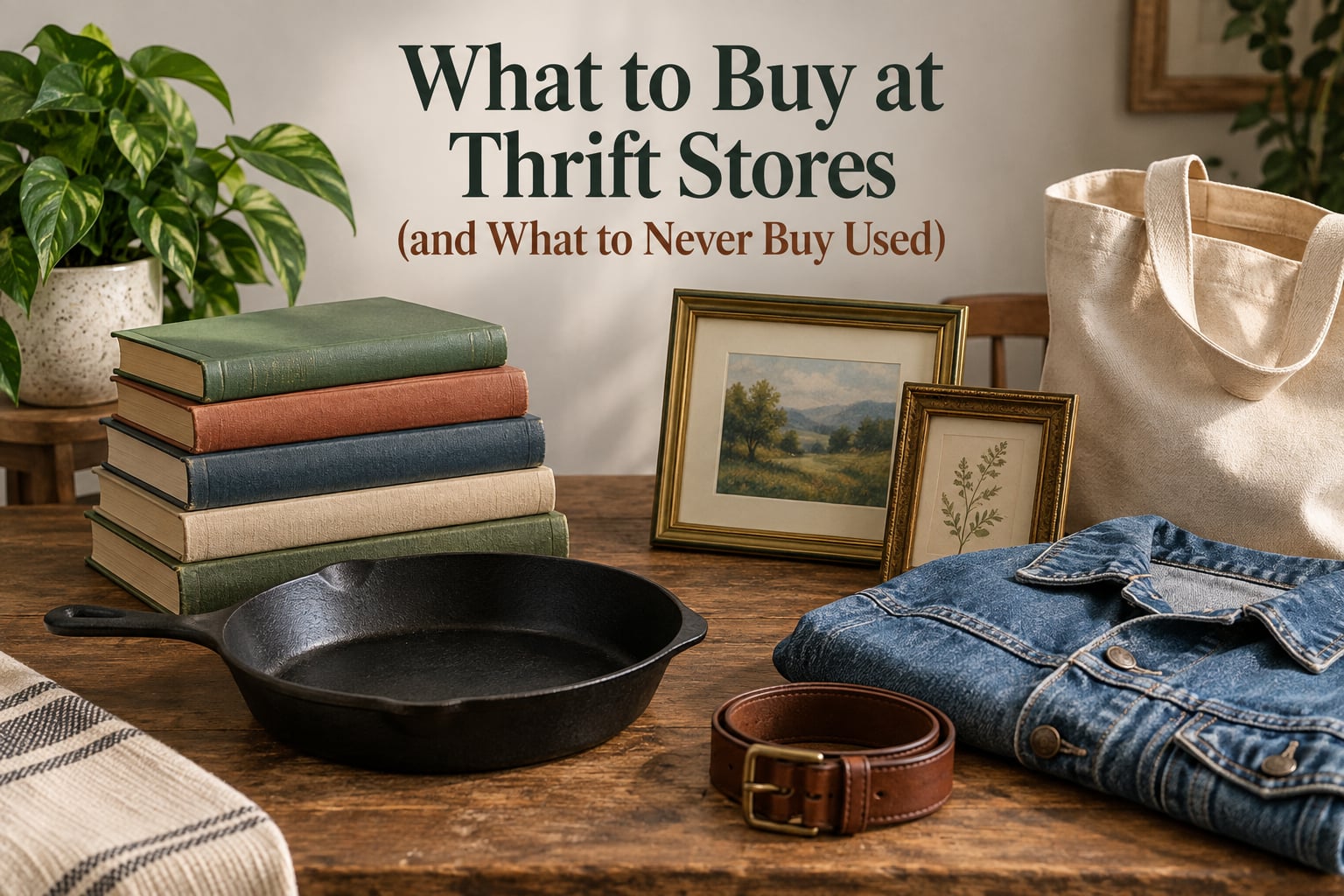
Thrift stores are one of the cheapest ways to furnish a home, clothe a family, and fill a craft room, but a small set of categories carries real health or safety risk no matter how good the price is. The short version: buy used books, kitchenware, picture frames, wood crates, hand tools, winter coats, leather belts, glassware, and tested small appliances. Never buy used car seats, cribs, helmets, mattresses, upholstered furniture, cosmetics, or anything with an old electrical cord.
That is the whole framework. Everything below just fills in the details: which categories pay off, which ones to walk past, and what to do about the things you have already brought home.
I have been buying secondhand for about fifteen years, mostly in Edmonton and Calgary, and my family has bought our entire kitchen, most of our outerwear, and a surprising amount of our Christmas gifts that way. I have also learned the hard way why the short list of hard-no categories exists. It comes down to four hazards, and once you can name them you can judge any item in about a minute.
Table of Contents
- The four hazards behind every secondhand rule
- What to Buy at Thrift Stores: 10 Categories We Come Back For
- 1. Books, especially hardcovers and textbooks
- 2. Cast iron, stainless, and vintage Pyrex-type glass
- 3. Picture frames, mirrors, and wall decor
- 4. Wood crates, boxes, baskets, and organizers
- 5. Hand tools and small hardware
- 6. Coats, denim, and structured outerwear
- 7. Belts, leather goods, and quality accessories
- 8. Specialty cookbooks and outdated recipe books
- 9. Glassware, vases, and stemware
- 10. Small appliances, but only ones you test in the aisle
- Buy, Maybe, or Never: The Master Thrift Shopping Table
- What to Never Buy Used (and What to Buy Instead)
- 1. Car seats and booster seats
- 2. Cribs, bassinets, and other infant sleep products
- 3. Bike, motorcycle, and ski helmets
- 4. Mattresses, box springs, and waterbeds
- 5. Upholstered furniture, cushions, and pillows
- 6. Cosmetics, razors, toothbrushes, and personal hygiene tools
- 7. Underwear, socks, and swimwear
- 8. Anything with a heat element or an old cord
- 9. Crock pots, slow cookers, and stoneware grills
- 10. Toys painted before 2009, and any item you suspect of lead glaze
- The tricky middle ground
- The 60-Second Inspection Checklist to Run Before You Pay
- How to Make a Used Find Safe Before It Enters Your Home
- Bed bugs: bag, freeze, steam, wash
- Moths in wool and cashmere
- Clothing and anything that touches skin
- Kitchenware
- Test electronics before you trust them
- When New Is Cheaper Than Thrift: The Categories That Changed
- Thrifting Rules Nobody Writes Down (Plus What Stores Won’t Take)
- Frequently Asked Questions
- What to avoid buying at thrift stores?
- What not to buy from a thrift store?
- What are the biggest thrifting mistakes?
- What are the unwritten rules of thrifting?
- What sells the most at thrift stores?
- What 6 things won’t thrift stores take?
- What are 8 things I should always buy at thrift stores?
- Conclusion: What to Buy at Thrift Stores in One Sentence
The four hazards behind every secondhand rule
Bed bugs. They travel in luggage, donated furniture, and secondhand clothing, and most chains treat or reject an entire donation load when an infestation is found. Every “never buy” rule about mattresses, upholstered furniture, and pillows traces back to this one.
Lead and other heavy metals. Vintage ceramic glaze and paint made before 2009 can contain lead. Public health guidance has long advised against letting children mouth toys painted before that year, and independent testing of vintage play sets has found lead levels far above the current standard.
Degraded elastic and foam. Swimwear, underwear, fitted sheets, pillows, and seat cushions lose their stretch and structure with age and heat. A stretched-out elastic band will not snap back, and a foam cushion that has turned powder does not recover.
Aged electrical components. Rubber insulation in cords cracks and becomes brittle, and old heat elements, gaskets, and batteries are the leading cause of thrift store fires reported on forums. Space heaters, toasters, irons, hair dryers, and humidifiers are the items people most often regret.
Almost every rule in this article is one of those four hazards wearing a different name.
What to Buy at Thrift Stores: 10 Categories We Come Back For
These are the categories where a thrift store regularly beats retail, new, with the savings large enough that a mediocre item in good condition is still a bargain. Each one has a “what to check” line so you can decide in the aisle.
1. Books, especially hardcovers and textbooks
Paperbacks are cheap everywhere, but hardcover fiction, coffee-table books, and out-of-print titles are where secondhand stores actually win. Textbooks in particular are priced by course demand, and the same title that sold out at a campus bookstore sits on a thrift shelf for a fraction of that.
What to check: flip through for foxing (brown spotting from damp), a musty smell, or pages that feel soft and wavy. Skip anything with active mold. For kids’ books, wipe the cover and wash your hands; for reference books, check the copyright page so you are not paying for an edition you already own.
2. Cast iron, stainless, and vintage Pyrex-type glass
Enameled cast iron is the single most-regretted-over item for people who do not own it. A well-seasoned pan in good shape is a lifetime purchase, and a lot of people buy one new, use it twice, and store it. Stainless steel mixing bowls, cake pans, sheet pans, and roasting pans are the same story: they do not wear out, they just accumulate in a cupboard.
What to check: enamel chips are permanent rust traps, so run a finger over the inside surface and reject anything with a chip. On cast iron, check for deep pitting on the cooking surface. Avoid anything with a flaking or peeling nonstick coating; that coating does not come back once it is damaged.
3. Picture frames, mirrors, and wall decor
This is the highest-margin category for beginners and the one that fills a wall in an afternoon. Frames, gallery-wall sets, wood wall signs, brass candlesticks, and trays appear constantly and cost almost nothing at a donation-based store.
What to check: for wood, tap the joints and look for softness or powdery areas that suggest dry rot. For glass and mirror, look for chips on the edge. For anything with hanging hardware, confirm the D-ring or French cleat is present and the screws are not stripped.
4. Wood crates, boxes, baskets, and organizers
Wooden crates, apple boxes, wicker baskets, and solid wood storage boxes are the backbone of cheap home organization. They also feed the upcycling crowd, which means demand keeps them from piling up.
What to check: splintering along the slats, and nail rust bleeding into the wood. A crate that has held produce outdoors for a decade can have a moldy interior that is not visible until you put your hand in it, so smell the inside.
5. Hand tools and small hardware
Thrift stores are an underrated source for hand tools, and a surprising number of sellers donate a whole garage bench rather than sort it. Screwdrivers, pliers, hammers, tape measures, levels, and socket sets work exactly the same as new ones.
What to check: rust is not an automatic fail on a wrench, but pitting on a joint means the jaw will not grip. For anything you cannot test, check the stamp for readable weight markings, and skip tools with cracked grips. Skip corded power tools and anything with a cut or taped cord.
6. Coats, denim, and structured outerwear
A wool or down winter coat is the best cost-per-wear find in any thrift store, and it is also the easiest to inspect. Denim jackets, structured blazers, and parkas hold their shape for years and suit people who do not want to wear the same thing everyone else has.
What to check: pull gently at a seam and look for shot threads or a gap. Check the armpit lining, the crotch of denim, and the inside of the pocket bags, which go first. Look for shine, wear, or thinning at stress points. Then smell it, because smoke and mustiness do not come out in a wash reliably.
7. Belts, leather goods, and quality accessories
Full-grain leather belts, purses, wallets, and watch straps are the accessories category where used genuinely beats new, because a used leather belt is already broken in and a new one is stiff. Scarves, brooches, and hair accessories fall in the same group of small items with a decent resale and reuse rate.
What to check: leather should smell like leather, not like glue or chemicals. Bend it sharply; a good hide creases and a bonded or plastic item cracks. Check for cracked edges or a flaking finish, and verify that belt holes have not been stretched to uselessness. Users on thrifting forums consistently say elastic is a fair “fix it yourself” item, but the same elastic inside underwear is not worth the effort.
8. Specialty cookbooks and outdated recipe books
Dated cookbooks are quietly valuable because they document ingredients, techniques, and brands that no longer exist, and because a lot of them were written for the ovens and appliances we still have. A regional or community cookbook is a good conversation piece as well as a usable book.
What to check: missing pages, a spine that falls open, and grease or splatter damage. Any book with a heavy scent of smoke is not worth the price, since the odor soaks into the paper and the binding.
9. Glassware, vases, and stemware
Good glass is heavy, cool, and rings when you tap it. Pressed glass, cut crystal, sturdy tumblers, and sturdy everyday vases appear regularly and last indefinitely if you avoid the two real hazards: lead glaze on anything decorative, and chips on the rim.
What to check: run a fingernail along the rim to find chips, and inspect the base for ground or polished spots, which are normal. Use a lead test stick on any brightly decorated piece from an unknown era, and only use a piece for food if the decoration is not on the eating surface.
10. Small appliances, but only ones you test in the aisle
Toasters, blenders, kettles, irons, coffee makers, and handheld mixers turn up often and usually work. The rule is simple: if you cannot plug it in and run it for thirty seconds before you pay, do not buy it.
What to check: the cord. Flex it at the plug and along its length; if the rubber is stiff, cracked, or smells burnt, walk away. Listen for anything that scrapes or smells hot, and never test an appliance that has been stored somewhere damp, because water inside a heating element is exactly how thrift fires start.
Buy, Maybe, or Never: The Master Thrift Shopping Table
This table is the whole article in one view. “Maybe” means buy it only if you are buying from someone you know, or only if you have a way to clean and test it before it matters.
| Item | Verdict | Why |
|---|---|---|
| Hardcover books, textbooks, out-of-print titles | Buy | No wear risk, no safety risk, deep discount on out-of-print editions |
| Enameled cast iron, stainless cookware, sheet pans | Buy | Outlasts the person who bought it new; inspect for enamel chips |
| Picture frames, mirrors, brass and wood decor | Buy | Cheap, repairable, no failure mode |
| Wood crates, boxes, baskets, organizers | Buy | Solid wood holds value; check for dry rot and mold inside |
| Hand tools without cords | Buy | Mechanical parts either work or are visibly broken |
| Coats, denim, structured outerwear | Buy | Best cost-per-wear category; check seams, lining, and smell |
| Leather belts, purses, wallets | Buy | Full-grain leather improves with use; reject bonded and plastic |
| Specialty and community cookbooks | Buy | Out-of-print content no new edition replaces |
| Glassware, vases, stemware | Buy | Test for lead on decorated pieces, reject rim chips |
| Small appliances with a return window | Maybe | Test for 30 seconds in the aisle; walk away from brittle cords |
| Shoes | Maybe | Check tread, insole, and glue; consider cost per wear against new |
| Baby bottles and bottle nipples | Maybe | Only from a source you trust; nipples harden with age and heat |
| Crock pots and slow cookers | Maybe | Sanitize the stoneware; some owners used them to strip lead paint |
| Vintage dinnerware with decorative glaze | Maybe | Display only unless a lead test clears the eating surface |
| Vehicles and tires | Maybe | Fine with an independent inspection, never on a retail-store promise alone |
| Car seats and booster seats | Never | Crash history is invisible and the shell ages past its limit |
| Cribs, bassinets, and infant sleep products | Never | Structures fail silently; paint and hardware age out of standard |
| Bike, motorcycle, and ski helmets | Never | The liner absorbs one impact only; you cannot see if it happened |
| Mattresses, box springs, and waterbeds | Never | Bed bug harbourage with no way to inspect or treat the inside |
| Upholstered sofas, chairs, and cushions | Never | Pests nest in the seams and foam breaks down to powder |
| Pillows, bed pillows, and baby comfort items | Never | Dead skin, sweat, and foam degradation; no wash reaches the core |
| Cosmetics, razors, toothbrushes, nail tools | Never | Used on someone else’s skin; bacteria and fungal spores transfer |
| Underwear, socks, and swimwear | Never | Elastic is spent, and hygiene items are not worth relaunching |
| Space heaters, toasters, irons, hair dryers, humidifiers | Never | Old cords and heat elements are the top reported thrift fire cause |
| Used electronics with a burned or missing cord | Never | Insulation is compromised and there is no recall history |
| Toys painted before 2009 | Never | Pre-2009 paint may contain lead; the finish is also more likely to chip |
What to Never Buy Used (and What to Buy Instead)
Ten categories where the discount does not come close to covering the risk. Each one lists the reason, then a fix that works, because a rule you understand is a rule you follow. One qualification first: nearly every rule below applies to items bought from a stranger. If you know the person, and the history is clean, the answer changes for helmets and car seats.
1. Car seats and booster seats
Reason: a car seat has an expiry date because the shell, the harness webbing, and the foam all weaken with age, and the expiry exists for a reason. The bigger problem is invisible: roughly half of used car seats on the market have been in a crash, and the frame can be bent while the seat still looks perfect. A recall may also apply to a model you never knew was affected.
The fix: buy these new. If money is the barrier, check your provincial program, the child passenger safety seat clinic, or your local family resource centre, which often run low-cost seat events. Do not buy a used seat from a stranger, and do not buy one from a friend unless they can tell you the date of manufacture, the model number, and the full accident history of the vehicle it was in.
2. Cribs, bassinets, and other infant sleep products
Reason: a used crib may have a loose or cracked slat, a stripped screw, a sagging rail, or paint that has chipped into a reachable surface. Drop-side cribs are older still and were subject to a long-running recall for entrapment and suffocation risk. Add-on sleepers, bumpers, and positioners have their own separate guidance and are not worth buying used at all.
The fix: buy the sleep surface new. In Canada, a used crib has to meet the current federal safety standard, which post-dates almost everything in donation circulation, so there is no safe way to verify it in the aisle. A hand-me-down crib rail or a used mattress sold new-in-wrapper is the most you should accept secondhand.
3. Bike, motorcycle, and ski helmets
Reason: a helmet’s foam liner is designed to absorb one impact and then stop working. A helmet that has been dropped, hit, or stored in heat can be compromised without any visible crack, and the shell and the visor hardware do not tell you what the liner has been through. Buyers on secondhand forums are consistent on this point: a helmet is the one safety item where the savings are never worth it.
The fix: buy new, and replace on any significant impact or at the manufacturer’s stated service life, whichever comes first. If you absolutely must buy used, buy from someone you know who can confirm the helmet has never been in a fall, and replace the visor and any peeling foam regardless. Scratched UV coating on a lens is a separate issue: a scratch that goes through the coating removes your eye protection.
4. Mattresses, box springs, and waterbeds
Reason: this is the category people are most tempted by, because nobody else wants them, and they are the number one bed bug trap. A mattress holds heat, sweat, skin cells, and a seam structure that bed bugs nest in, and you cannot see or steam the inside. Foam breaks down to powder, and a waterbed carries its own plumbing failure risk. Donation chains generally do not even accept mattresses for this reason, which is itself a useful signal.
The fix: buy new, or buy a new mattress enclosed in plastic from a retailer that refuses used mattresses. This is the one category where the secondhand market genuinely has no legitimate supply chain. If you have found a box spring at a store, assume you are buying a possible infestation and not accept it.
5. Upholstered furniture, cushions, and pillows
Reason: bed bugs and other pests live in seams, welts, and the underside, and the interior foam is not washable. Foam in older pieces has also degraded into a powdery material that will not support you. Buying a couch online without seeing it in person is how people end up with a piece that reeks of smoke, cat, or damp.
The fix: furniture bought from a stranger is not the buy. Buy from a neighbour or a friend you can visit in their home, or from an upholsterer who sells reupholstered frames. A cheaper middle path is solid wood or metal-frame furniture, which is inspectable and steam-cleanable, and then source new cushions and upholstery fabric separately.
6. Cosmetics, razors, toothbrushes, and personal hygiene tools
Reason: these were on someone’s face, mouth, or skin. Bacteria, fungal spores, and viruses transfer on razors, tweezers, nail clippers, toothbrushes, and cosmetic surfaces, and cosmetics degrade after opening in ways nobody can see. Forum advice is uniform on this one: personal hygiene items are a hard pass, no cleaning method short of throwing them out makes them worth owning.
The fix: buy new, and use a donation drop-off for unopened items you want to discard rather than putting them back into circulation yourself. Expired makeup is generally a waste bin, not a donation.
7. Underwear, socks, and swimwear
Reason: elastic has a lifespan. Once it is shot, no amount of laundering brings it back, and swimsuits, sports bras, and fitted items fail at the seams first. There is a hygiene side as well. Secondhand underwear is not worth relaunching even after a hot wash, and users in secondhand discussions agree on the odd pairing of things: replacing elastic in a costume is cheap, replacing it in underwear is not worth doing.
The fix: buy these new, always. A one-of-a-kind vintage bra is the obvious exception, and it is the single underwear-adjacent purchase with a real case for buying used, provided the elastic is still firm and there is no odour or staining.
8. Anything with a heat element or an old cord
Reason: space heaters, toasters, ovens, irons, curling irons, hair dryers, and humidifiers are the items most often named in thrift fire stories, and the cause is consistent: rubber insulation in old cords becomes brittle, plugs and elements loosen, and a machine that sat in damp storage can short out on first use. Humidifiers and vaporizers add a microbial risk: sitting water and warm internal surfaces grow organisms, and the tank is impossible to fully sanitize.
The fix: buy these new. If a used one is a non-negotiable gift or an inherited item, replace the entire cord with a modern one, inspect the plug prongs for discoloration, test it on a non-critical outlet away from anything flammable for an hour, and never run a heater unattended or under furniture.
9. Crock pots, slow cookers, and stoneware grills
Reason: this is a good story rather than a rule, and it is worth knowing. Secondhand slow cookers show up in thrift discussions because a few owners used them to strip lead-based paint off hardware before selling the piece, and old crock pots are impossible to fully clean in the grooves of the stoneware. If you are a thrifter in a city with a lot of older housing stock, assume that is possible.
The fix: treat any used crock pot as display only, and buy a new one if you want to cook in it. A lead test stick on the stoneware glaze settles the question in a minute.
10. Toys painted before 2009, and any item you suspect of lead glaze
Reason: public health agencies have advised for years that toys made before 2009 may contain lead paint, and independent testing of vintage play sets has returned figures many times the current limit. On the kitchen side, decorative glaze on older ceramics can carry lead and cadmium, and the danger is specifically the food contact surface, not the pretty pattern on the rim.
The fix: skip old painted toys once a child is in the house, and use a lead test stick on any pre-2009 toy you keep for yourself. For vintage dishes, use them for display, or test the glaze on the surface that touches food and only serve from pieces that pass.
The tricky middle ground
Three items that are not a hard no but need a specific test. Shoes: inspect the tread depth, look for separation between the sole and upper, and check the insole for compression; a good leather shoe is fine used, a glued synthetic one rarely survives. Bottles and nipples: the bottle may be fine if it is not cracked or cloudy, but nipples harden with age and heat and must be bought new. Electronics: this is the counter-narrative worth stating plainly, because the blanket “never buy used electronics” claim is wrong. Plenty of thrifting enthusiasts have bought dozens of used audio and network devices with zero failures.
The real risk with used electronics is not the used status, it is three specific things: you have no return window, you cannot see the cord, and you do not know how many generations old the model is. Buy used electronics only from a seller with a return window, only when the cord is flexible and undamaged, and only for a model that is recent enough to still receive security updates. Everything else goes in the new pile.
The 60-Second Inspection Checklist to Run Before You Pay
Eight things you can do in the aisle with no tools, in the order that catches the most problems fastest. Most thrift mistakes are not bad deals, they are bad inspections.
1. Smell it. A musty, mildewy, smoke-soaked, or sharp chemical smell is a walk-away on its own, and it is the fastest test there is. Items from estates where someone died often carry a heaviness people describe as impossible to remove.
2. Check for bed bugs. Look at seams, welts, and the underside of cushions for rust-coloured spotting, tiny dark specks, shed skins, or a faint sweet smell. Check books and picture frames for the brown spotting they leave. If you are unsure, bag the item and freeze it before you decide.
3. Flex every cord. Bend the cord at the plug and at several points along its length. Stiff, cracked, patched, taped, or brittle rubber means the insulation is gone. Smell the plug area for burnt plastic.
4. Find the date stamp. Car seats, helmets, electronics, batteries, and appliances all carry one, and the date stamp settles the decision faster than anything else in this list. If there is no stamp, assume the worst supported date.
5. Test the elastic and the structure. Pull gently on waistbands, hems, and cuffs; look for a repair, a gap, or a fabric that no longer returns. On wood, press a screw head and tap a joint to check for softness and dry rot.
6. Check the whole surface, not the front. Flip it. Lift the cushions. Look under the collar, inside the pockets, at the back of the frame, and along the bottom edge. That is where thrift fires and thrift finds hide.
7. Price check on your phone. Search the exact model and condition while you are standing there. Then run the cost-per-wear math: a thrift price divided by a realistic number of wears or uses, compared against the new price divided by the same number. Most thrift items fail this test more often than buyers expect, which is the next section.
8. Ask the markdown. Name the flaw, point at it, and ask. Price tags in donation stores are set from an internal rubric, not from the item in front of you, and a visible stain or a missing part is nearly always a markdown. Ask when the colour-tag day is, and check whether the item is already on hold.
How to Make a Used Find Safe Before It Enters Your Home
What you can safely buy secondhand is only half the story. The other half is what you do in the 24 hours after you buy it, and this is the part that no competitor page covers.
Bed bugs: bag, freeze, steam, wash
Put a suspect item in a sealed bag the moment you get home and freeze it for a full 24 hours at -18C or colder, then keep it sealed until the day after so the thawing cycle does not hatch anything. A garment steamer or a steam cleaner on upholstery, working the seams and the underside thoroughly, kills exposed bed bugs and their eggs; the freezer step is what gets the ones hiding in the frame. Wash bedding and clothing hot and dry on high heat. Skip the DIY pesticide route: bug bombs do not reach bed bugs living in seams and they leave residue you then have to remove from a piece you just paid for.
Edmonton makes this easy, and it is a genuine local advantage. At -25C or colder you can leave a bagged item on an outdoor balcony or in the yard for two days, which is also a natural way to kill moths in wool and cashmere without a chest freezer. Double-bag before you bring it in, and freeze again before you unwrap, so you do not walk an infested coat into the house.
Moths in wool and cashmere
This is the loss nobody warns you about, and it happens in a closet within a few months. Before you store any thrifted wool, cashmere, or felt item, freeze it for 72 hours and then store it sealed, in a breathable bag with cedar blocks or lavender, away from a wall you can smell. Give coats and knitwear a proper dry cleaning or a careful hand wash and dry before they go anywhere near a closet, because the eggs are usually in the fabric, not on the surface, and a single untreated find can ruin a season’s worth of wool.
Clothing and anything that touches skin
Wash thrifted clothing before anyone wears it, especially children’s clothes, and wash it separately the first time. Sanitize zippers, buttons, and snaps with a wipe, and run a no-heat or low-heat dryer cycle for a few minutes to knock out whatever the wash cycle leaves behind. Pay attention to the labels: secondhand baby clothes are worth buying new, but secondhand baby equipment is where the recall risk lives, so check Health Canada’s recalls and product safety database for anything bought secondhand.
Kitchenware
Wash cast iron with soap and water, dry it fully on the stove, and give it a thin coat of oil if the seasoning looks thin or patchy. Test any pre-2009 or brightly decorated ceramic with a lead test stick, on the glaze, before you serve food from it. Replace any nonstick pan whose coating is scratched or flaking rather than trying to reseason it. Replace rubber gaskets, seals, and hoses on appliances, which are cheap parts and the ones that actually fail.
Test electronics before you trust them
For anything you did not test in the aisle, run it for a full charge cycle or thirty minutes of use at home, outside the bedroom, before it goes anywhere near your network. Replace the cord before anything else if the original is not present. Check the Health Canada recall database for the model number before you buy it at all, and check the manufacturer’s support page for how long security updates are still available.
When New Is Cheaper Than Thrift: The Categories That Changed
Some thrift categories have stopped being a bargain, and this is the part most thrifting guides will not tell you. Thrift prices have crept up while sale pricing at big-box retailers got sharper, so on a handful of ordinary items the secondhand route now costs more than the new one.
The reliable test is cost per wear, and it is simple. Divide the price by the number of times you will realistically use the item. A work coat you wear 250 times a year for four years is 1,000 wears; anything priced low against that number wins. A novelty mug used four times a year for two years is eight wears, and almost nothing on a thrift shelf beats new on that math.
In practice, everyday basics, plain small appliances, plain tights and socks, standard cookware sets, and common furniture lines are the categories where a sale price at a major retailer frequently undercuts a donation store. Bed linens, curtains, and moving boxes are the same. Specialty categories are untouched: a hardback edition, a full-grain leather belt, a good cast iron pan, a printed photo frame, and a well-made coat still land on the thrift side of the line every time.
Two practical rules follow. A “colour tag” day discount and a friendly markdown are how you make a borderline item work, because the asking price is arbitrary. And if a category is your everyday purchase rather than an occasional one, buy the new one on sale and save your thrift hours for the things that are genuinely hard to find.
Thrifting Rules Nobody Writes Down (Plus What Stores Won’t Take)
The unwritten rules are the reason two people can spend an hour in the same store and leave with very different results. Most of them are about timing, manners, and knowing what the staff already know.
Go on weekday mornings. The best donations are on the floor before opening, sorted but not yet browsed, and the marked-down carts appear mid-morning rather than at close. Saturday is when you find other bargain hunters, not bargains.
Learn your store’s rhythm. Ask at the desk when the markdowns and the colour-tag day fall, and when a donated load is likely to be processed. Sign up for the email list; donation chains send out tag-day notices before they hit the racks.
Ask a staff member what did not sell. A friendly question about what has been on the floor since summer, or whether anything is waiting to be donated, gets you pointed at the real leftovers. It is also how you learn which donation centre near you will not take large items, which saves you the truck trip.
Do not re-rack. Volunteers and staff sort, price, and steam everything. Put things back where they came from, and hand anything with pests to the desk rather than to another shopper.
Bag it before you leave the lot. Do not put thrifted clothing into a car seat or a stroller and then sit in it, and put suspect items in garbage bags until they are cleaned. Keep a dedicated bag in the trunk for the trip home, and wash everything before it enters the house.
Local sourcing, Edmonton and Alberta. Expect a mix of national chains, independent consignment shops, and a rotating set of donation depots that move between neighbourhoods across the year, so check before you drive out. Second Cycle, local consignment, and university-area stores near campus run their own economics and are often worth a separate trip, because donated school gear behaves differently. Winter stock, especially coats and boots, arrives on a cycle tied to donation drives rather than to the calendar, and the cold makes the leather goods and the wool stock worth the trip on a clear day. Buying from a neighbour who is downsizing, or from a family member, beats every store on the friend-versus-stranger rule that this article keeps coming back to.
On the other side of the counter, here are the six things thrift stores and donation centres generally will not take, and what to do instead. Mattresses and box springs, for the reasons above; ask about recycling programs instead. Car seats, cribs, and infant equipment, because of recalls and expiry; take them to a household hazardous waste site. Recalled electronics, and in many cases any electronics at all; check municipal e-waste days. Soiled, mouldy, or infested items, and that includes mattresses, some upholstered pieces, and building materials; there is no responsible second route for these. Opened cosmetics and personal care products, by policy and for good reason; many accept unopened sealed items. Toilets, bathtubs, and other large fixtures, which take up the floor space a store cannot spare; pass those to a renovation reuse store or a salvage yard instead.
Frequently Asked Questions
What to avoid buying at thrift stores?
The items to avoid are car seats and booster seats, cribs and infant sleep products, helmets, mattresses and box springs, upholstered furniture, pillows, cosmetics, razors and toothbrushes, underwear and swimwear, space heaters and other heat-element appliances, and old toys painted before 2009. The common causes are bed bugs, invisible crash history in car seats and helmets, lead paint and lead glaze, degraded foam and elastic, and brittle old electrical cords. If an item falls on this list from a stranger, buy it new.
What not to buy from a thrift store?
Do not buy mattresses, box springs, upholstered sofas and chairs, pillows and cushions, cribs and bassinets, car seats, bike and motorcycle helmets, undergarments, swimwear, cosmetics and razors, small personal hygiene items, space heaters, toasters, irons and humidifiers with aged cords, and pre-2009 painted toys. The single most common mistake is buying a mattress or a couch, because nobody else wants them and they are often nearly free. Check for bed bugs in every seam before you pay for any upholstered item.
What are the biggest thrifting mistakes?
The biggest mistakes are buying without inspecting, ignoring smell, not checking cords and date stamps, buying furniture you cannot test, and paying thrift prices for items that are cheaper new. Running a 60-second inspection in the aisle prevents most of them: smell it, look for bed bug spotting in the seams, flex every cord, find the date stamp, test the elastic, check the underside, price check on your phone, and ask for a markdown on any visible flaw.
What are the unwritten rules of thrifting?
Go on a weekday morning before opening, learn when the store does markdowns and colour-tag days, sign up for the email list, and ask staff what has been on the floor longest. Never re-rack stock or steam items yourself. Bag purchases in the parking lot rather than putting thrifted clothing into a car seat, and wash everything before it enters the house. Buying from a neighbour or family member always beats buying the same item from a stranger.
What sells the most at thrift stores?
The highest-turnover categories are books, brand-name clothing and denim, coats and outerwear, shoes, handbags, kitchenware and cookware, glassware, and small working appliances. These move quickly because they are cheap, useful, and easy to inspect. Slow-moving stock is generally large furniture, boxed electronics, and seasonal decor, which is also why those are the categories where a markdown is easiest to get. If you are reselling rather than using, pockets, handbags, denim, and vintage kitchenware hold value best.
What 6 things won’t thrift stores take?
Donation centres and thrift stores commonly will not accept mattresses and box springs, car seats, cribs and infant equipment, recalled electronics, items that are soiled, mouldy, or infested, opened cosmetics and personal care products, and large fixtures such as toilets and bathtubs. Some also decline building materials and recalled appliances. For each of these, check your municipal household hazardous waste and e-waste days, which handle car seats, electronics, and paint far better than a donation centre can.
What are 8 things I should always buy at thrift stores?
Always buy books and out-of-print hardcovers, enameled cast iron and stainless cookware, picture frames and mirrors, wood crates and boxes, hand tools without cords, coats and structured outerwear, full-grain leather belts and wallets, and specialty cookbooks. Glassware and vases are also excellent value if you test for lead glaze and reject rim chips. These categories do not degrade, are easy to inspect, and routinely cost a fraction of the new price.
Conclusion: What to Buy at Thrift Stores in One Sentence
Buy secondhand anything that does not hold a body, a wire, or a memory of someone else: books, cookware, frames, crates, hand tools, coats, leather belts, cookbooks, and glassware. Walk past car seats, cribs, helmets, mattresses, upholstered furniture, cosmetics, undergarments, and anything with a heat element or a brittle cord, and buy those new, no matter how good the deal looks.
Everything in between is handled by the same two tools: the 60-second inspection in the aisle, and the 24-hour cleanup when you get home. Those two habits are the difference between a haul you are happy with and one you are still dealing with in 2026.
Last reviewed in October 2026.