
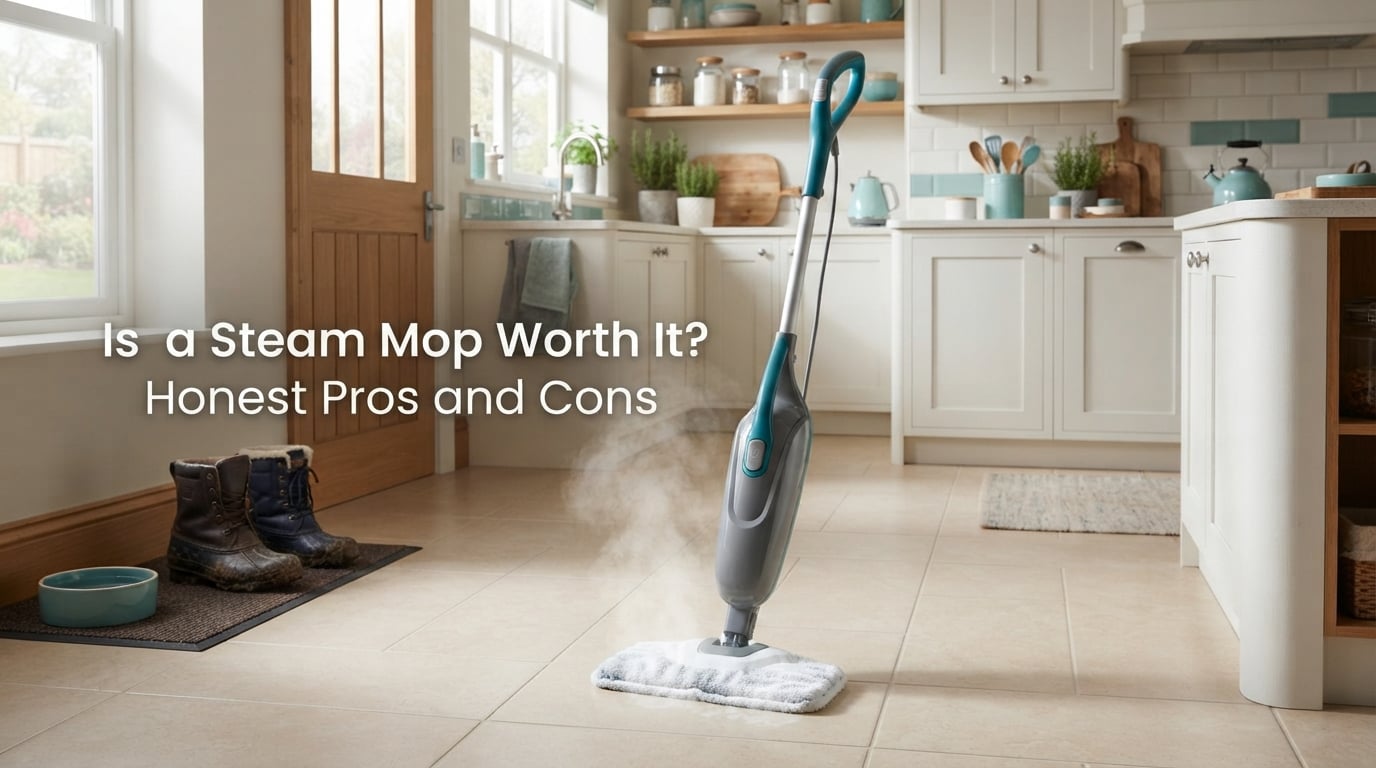
Yes, a steam mop is worth it if your floors are sealed hard surfaces like ceramic tile, porcelain tile or sheet vinyl, and you want to sanitize without chemicals. It is not worth it on unsealed or waxed wood, glued or peeling vinyl, or laminate, and it is often a waste of money in a small space with no storage. That is the honest answer, and the rest of this guide explains exactly where that line sits and why most roundups never say it out loud.
A steam mop is an electric floor cleaner that heats tap water in an onboard tank, pushes the resulting steam out through a nozzle, and drives it into a washable microfiber pad that absorbs the loosened grime. No soap, no bucket, no wringing out a dirty rag over a sink.
Over the last few years I have used steam mops in two very different homes: a rented condo with laminate everywhere and a family house with a sealed tile kitchen and a mudroom that takes a beating every winter. The difference in results between those two floors is the entire answer to whether this purchase makes sense for you.
Table of Contents
- The Short Answer: Is a Steam Mop Worth It?
- The Pros of Owning a Steam Mop
- 1. It sanitizes without a single cleaning chemical
- 2. No bucket, no wringing, no recontaminating your mop
- 3. It loosens dried-on grime that a flat mop just smears
- 4. Maintenance is genuinely low
- 5. Self-standing storage
- 6. The attachments handle above-the-floor jobs
- 7. Grout and tight corners get real attention
- The Cons Nobody Mentions
- What Floors Should Not Be Steam Mopped?
- Cordless Steam Mops: Read the Fine Print
- What It Really Costs Over Time
- Is Steaming Floors Better Than Mopping?
- Who Should NOT Buy a Steam Mop
- Who Should Buy One
- A Cold-Weather Reality Check for Edmonton Homes
- How to Use a Steam Mop Safely
- What’s the Best Steam Mop to Use?
- What Is the Healthiest Way to Mop Floors?
- Alternatives That Cost Less
- Frequently Asked Questions
- Final Verdict
The Short Answer: Is a Steam Mop Worth It?
A steam mop is worth it when your home has a lot of sealed hard flooring, high traffic through entryways, kids or pets creating messes, and a real interest in cutting household cleaning chemicals. The steam reaches a temperature high enough to kill germs and bacteria on a sealed surface, which no ordinary mop reliably manages without leaving a chemical film behind.
It is not worth it if your flooring is unsealed or waxed wood, glued or peeling vinyl, or laminate flooring, if you live in a compact space with nowhere to stand the unit upright, or if you already own a microfiber flat mop and a spray bottle that does the job well enough.
Here is the blunt version: the machine is a genuinely good tool and a mediocre investment. Most of the value comes from the floors underneath it, not from the appliance itself.
The Pros of Owning a Steam Mop
Seven benefits are worth understanding before you decide, and they are the reasons people keep these machines well past the novelty stage.
1. It sanitizes without a single cleaning chemical
Steam at sanitizing temperature kills germs and bacteria on contact. Good Housekeeping’s lab protocol for testing sanitizing claims calls for about 20 seconds of steam exposure on a spot, or roughly 15 passes over the same area. No sprayed residue, no fumes, no film for pets or small children to walk through barefoot.
2. No bucket, no wringing, no recontaminating your mop
Traditional mop-and-bucket setups get unhygienic fast. The dirty water sits in the bucket, the pad goes back in, and you spread the same contamination back across the floor. A steam mop self-contains the water, so there is no dirty reservoir to smell up a corner of your basement.
3. It loosens dried-on grime that a flat mop just smears
Heat does the work of time and elbow grease. Dried milk, dried-on cereal, tracked-in winter grit and sticky kitchen spills soften and lift. A microfiber flat mop on the same mess usually just redistributes it into a thin film.
4. Maintenance is genuinely low
Pads are washable and most are dishwasher safe, which means the daily habit is pop the pad in the machine or the sink and hang it to dry. There is no solution to mix and no stripping to rinse. That low daily friction is the single biggest reason people keep using one.
5. Self-standing storage
Most modern units park upright on their own base, so they stand in a closet corner or beside the washer without a wall hook. In a home with hard floors, that is a small quality-of-life difference you notice every time you put it away.
6. The attachments handle above-the-floor jobs
A detachable handheld steamer on many models turns the same unit into a tool for curtains, upholstery, window frames, grills and the side of the fridge. The extension for above-the-floor work usually needs a different tool, so this is a real second use.
7. Grout and tight corners get real attention
The triangular or swivel head fits into grout lines and along baseboards in a way a flat rectangular mop cannot. A narrow brush attachment lets you work individual spots without soaking the surrounding floor.
Myth vs fact: the 99.9 percent of germs claim on the box is not a universal guarantee. It depends on the temperature the unit actually reaches, how long you hold steam on a spot, and whether the surface is sealed. On a porous or unsealed floor, treat the claim as marketing until proven on your specific floor.
The Cons Nobody Mentions
These are the drawbacks that roundup pages leave out because they always end in a purchase recommendation. If any of them hits your situation, the answer is probably no.
1. Weight and arm fatigue
These are not light devices. Water plus boiler plus head adds up, and by the time you have mopped two rooms your shoulder and wrist are telling you about it. Anyone with shoulder or wrist problems will feel this fast.
2. Cord dependence and outlet proximity
Every real steam mop has a cord. The power draw means a dedicated outlet rather than a shared one with a space heater, and the tank has to be refilled whenever you run it dry. You are cleaning around the cord, not freely.
3. Wet floors and slip risk
Steam reintroduces moisture. A freshly steamed tile floor is wetter than you expect, and out-of-control children, a slippery tile entryway, or a hardwood floor left damp too long can all turn a helpful tool into a problem.
4. Small tanks mean constant refills
Tank capacity is usually modest, and coverage per fill depends heavily on how dirty the floor is. On a heavily soiled area you can empty a tank several times in one room, which is where the convenience argument starts to wobble.
5. Ongoing costs add up quietly
Microfiber pads wear out and lose pickup. Anti-scale cartridges or filters are needed in hard-water areas. Fragrance discs are an optional add-on that some households buy by reflex. None of these are expensive individually, and together they are a slow monthly drip rather than a one-time purchase.
6. It will not deep-clean grout on its own
Steam is a sanitizing and surface-cleaning tool. Whitening grey, decades-old grout is a different job that needs a stiff brush, a proper cleaner and real scrubbing. Expecting one to restore grout sets you up for disappointment.
7. Heat-up time and a learning curve
Units typically need from 20 seconds to a couple of minutes to reach working temperature, and some build pressure before they output steady steam. There is an adjustment period where you learn how hard to press, how long to dwell, and how quickly to move. Many disappointing early reviews are really just impatient first-week reviews.
The user consensus pulled from the Reddit discussion that surfaced for this question is genuinely split. One recurring comment in that thread goes: “I’ve had several different steam mops but never felt like my floors ever got clean, no matter how often I mopped.” Other users in the same conversation praise quick chemical-free cleaning on tile. Both experiences are real, and the difference between them is usually floor type and expectations.
What Floors Should Not Be Steam Mopped?
Never steam unsealed wood, waxed wood, glued or peeling vinyl, or laminate flooring. These materials can absorb moisture, warp, swell, delaminate or void a manufacturer warranty, and steam held stationary on a wood floor can damage the finish. The floor type check is the single most important step before you buy anything.
| Floor type | Steam safe? | Notes |
|---|---|---|
| Ceramic and porcelain tile | Yes | Best use case. Grout lines benefit most from the narrow head and brush attachment. |
| Sealed hardwood | With caution | Only if the finish is factory-sealed, the warranty allows it, and you never park the hot mop on the wood. |
| Sheet vinyl | Yes | Generally safe as a continuous, non-porous surface. |
| Laminate flooring | No | Seams can swell and the wear layer can delaminate. Many testing labs advise against it entirely. |
| Waxed or oiled wood | No | A wax or oil finish is not a seal. Heat softens it and the wood takes moisture. |
| Unsealed or bare wood | No | Absorbs moisture directly. This is the fastest way to ruin a floor. |
| Glued or peeling vinyl tile | No | Steam weakens adhesive and lifts seams and edges. |
| Grout lines | Careful | Steam cleans and sanitizes grout, but it will not whiten discoloured grout on its own. |
One warning deserves repeating because it appears in the top search results and in real user accounts alike: never leave a hot steam mop standing still on a wood floor. Park it on its base, on tile, or on a hard non-wood surface. The concentrated heat in one spot is what causes finish damage, not the act of mopping itself.
Check your floor warranty before you buy. Several manufacturers explicitly exclude steam or hot-water cleaning, and doing the wrong thing can cost you a claim.
Cordless Steam Mops: Read the Fine Print
Most products marketed as cordless steam mops do not produce true steam. Good Housekeeping puts it plainly: cordless units do not make steam, and genuine steam mops all have cords. What the cordless products actually do is spray a fine mist of warm water through a battery-powered motor, which is a different category of cleaning entirely.
That distinction matters because a mist dampens the floor without the heat needed to sanitize it or the sustained pressure needed to lift dried-on grime. It is closer to a spray mop with extra steps, and it is worth asking any seller directly whether the unit has a boiler, because a marketing page will not volunteer the answer.
How to tell in thirty seconds
- Look for a stated heat-up time. If a product has one, it is heating water.
- Look for an internal boiler or a water tank rated in cups, not millilitres of a spray bottle.
- Look for a power cord in the specifications.
- Check whether the manufacturer claims sanitizing performance or only a sanitized-surface marketing line.
What It Really Costs Over Time
The upfront tier is only the first line of the bill. The honest cost question is what a steam mop costs you across three years of regular use, and how that compares with the alternatives you would otherwise buy.
I have deliberately kept figures out of this comparison, since pricing moves constantly. What matters is the shape of the spending: a steam mop front-loads more money on day one, then asks for small recurring purchases. A flat mop front-loads almost nothing and asks for a replacement pad every few months.
| Cost item | What it covers | How often | Relative weight |
|---|---|---|---|
| Upfront machine | The unit itself | Once | Highest single cost by far |
| Microfiber pads | Washable, but they fray and lose pickup | A few per year depending on use | Low, recurring |
| Anti-scale cartridge or filter | Mineral buildup from hard water | Every few months | Low, recurring, easy to forget |
| Fragrance discs | Optional scented steam | Monthly if used | Optional, pure preference |
| Electricity | Boiler heating water | Every use | Small but permanent |
| Microfiber flat mop comparison | Frame plus replacement pads | Pads periodically | Minimal both up front and over time |
| Sponge mop and bucket comparison | Frame plus sponge replacement | Sponge every few months | Minimal, but daily labour is higher |
Two cost facts are worth keeping in your head. First, pads, cartridges and filters are sold by the brand, and availability in Canada is thinner than in the United States, so check before you buy rather than after. Second, the electricity cost is real but small; the money that actually changes is the upfront machine price.
Is Steaming Floors Better Than Mopping?
Steaming is better than mopping on sealed hard floors for sanitizing and for dried-on grime, and worse for cost, storage and versatility. A mop and bucket handles any floor and costs almost nothing. A microfiber flat mop is the cheapest good option and is what most homes should actually use. A steam mop wins specifically on sanitation and chemical-free deep cleaning of sealed surfaces.
| Category | Steam mop | Mop and bucket | Microfiber flat mop |
|---|---|---|---|
| Sanitizing sealed floors | Strongest | Weak without chemicals | Moderate with the right solution |
| Dried-on grime and stuck spills | Very good | Good with soaking | Fair to good |
| Chemical use | None | Detergent and dirty water | Spray solution, light |
| Floor compatibility | Sealed hard floors only | Any hard floor | Any sealed hard floor |
| Daily labour | Low, refills and cords | High, wringing and rinsing | Low, rewash the pad |
| Storage footprint | Needs an upright parking spot | Bucket takes floor space | Minimal, flat against a wall |
| Ongoing consumables | Pads, cartridge, optional scent | Sponge, detergent | Pads, spray |
| Above-the-floor use | Yes, with attachments | No | No |
Notice the row that decides it for most people. Sanitizing is the steam mop’s clear win, and for many households the flat mop’s performance is already good enough that the win does not justify a dedicated appliance.
Who Should NOT Buy a Steam Mop
Skip this purchase if any of the following describes your home. This is the section the roundup competitors never publish, and for these readers it saves real money.
1. Renters
You are steaming someone else’s floor, and the finish may be unsealed or waxed. The downside lands on the owner, not on you.
2. Mixed-flooring homes
Hardwood in the living room, laminate in the bedrooms, tile in the kitchen means swapping tools constantly. A flat mop handles all of them without thinking about it.
3. Small spaces with no storage
A steam mop needs an upright parking spot, a nearby outlet and somewhere to dry a pad. In a compact condo that is three sacrifices for one benefit.
4. Households that already own a flat mop or a robot vacuum
If daily hard-floor cleaning is already covered, a steam mop becomes a specialist tool you use twice a year. Specialists are not necessarily bad value, but they are not everyday value.
5. People with mobility or grip concerns
The weight, the standing posture and the moving head are real barriers. Push-button spray mops exist for exactly this reason.
6. Fragrance-sensitive or chemical-avoidant households
Steam itself is unscented, which is a genuine plus. But fragrance discs are sold for these units, and the wet, warm air can stir up odour from carpets and upholstery nearby. If scent is a trigger, skip the optional extras and test carefully first.
Who Should Buy One
A steam mop earns its counter space in a fairly specific set of homes.
- Large sealed-tile kitchens. Tile is the surface steam handles best, and grout lines in a busy kitchen benefit more than almost anything else in the house.
- Families with kids or pets. Sanitizing without a chemical film matters when a toddler or a dog is on the floor within minutes of cleaning.
- High-traffic entryways and mudrooms. Tracked-in grit is exactly the problem heat and pressure solve well.
- Households actively cutting cleaning chemicals. If your goal is fewer bottles under the sink and less volatile organic compound exposure, this is a real step in that direction.
- Allergy and scent-sensitive homes that stay away from sprays. Water and heat leave no scented residue behind.
- Anyone cleaning above the floor too. If you want one tool for curtains, upholstery and window frames as well as floors, the handheld attachment earns its place.
A Cold-Weather Reality Check for Edmonton Homes
Local climate changes the math more than most product pages admit. Between November and March, road salt and grit get tracked onto entryways, and they dry and harden into the floor rather than sitting loose.
On sealed ceramic or porcelain tile, a steam mop is excellent here. Heat softens the dried salt film, the pad lifts the grit, and the steam sanitizes a surface where shoes have been coming and going all day. In a home with a sealed mudroom tile floor, this is the single most convincing demonstration of what the appliance does.
On laminate or unsealed wood, the same salt is the reason to walk away. Grit plus moisture plus heat plus a swelling wear layer is a recipe for a damaged floor, and a replacement panel in a winter is not a cheap lesson. Check the floor type first, and if there is any doubt at all, seal the floor properly or choose a different tool.
One local tip: dry sweep the grit before you steam. Vacuuming or sweeping first means the steam is doing disinfection work rather than moving gravel around, which is both faster and kinder to your pad.
How to Use a Steam Mop Safely
Six habits cover almost every damage report, injury and disappointment associated with these machines.
1. Pre-clean the floor
Sweep or vacuum first. Steam sanitizes a surface, but it does not pick up grit, and grinding debris into a wet pad scratches the finish and dulls the pad permanently.
2. Keep the nozzle moving
Never hold a steam mop still on one spot. Continuous motion is what lifts grime and what prevents a concentrated heat patch from forming. Slow and steady beats slow and stationary.
3. Never park it hot on wood
Return it to its base, or stand it on tile or another hard non-wood surface. This one habit prevents most of the finish damage people report online.
4. Empty and dry the tank after every use
Standing water plus heat inside the tank is how mineral scale builds up, and scale is what reduces steam output over time. Emptying the tank and running it briefly with fresh water keeps the boiler clean and the output steady.
5. Respect the cord and the outlet
Plug into a dedicated outlet rather than a shared one, keep the cord out of your walking path, and unplug by the plug rather than yanking the cord. Winding the cord loosely also protects it from the internal damage that causes the intermittent power faults people report after a year of use.
6. Let the pad dry before reusing it
A damp pad re-lays grime instead of absorbing it. Hang pads to dry, wash them according to the instructions, and replace them when the pile goes flat and they stop picking up.
What’s the Best Steam Mop to Use?
There is no single best steam mop, because the right answer depends on your floor and your storage. Judge a candidate on these criteria instead: a removable water tank with a wide opening that you can fill in a sink; a triangular or swivel head that reaches grout lines and tight corners; adjustable steam settings so you can dial down on more sensitive surfaces; a self-standing body that parks upright; a cord long enough to reach an outlet from where the work actually happens; and reliable local availability of replacement pads and anti-scale cartridges, which is harder to find in Canada than in the United States.
Pay attention to the warranty terms regarding floor use as well. Some manufacturers cover the machine generously and say nothing useful about floors, and some exclude wood and laminate entirely. Read that line before you buy, not after a problem appears.
What Is the Healthiest Way to Mop Floors?
For most homes the healthiest way to mop floors is a microfiber flat mop with a small amount of a low-volatile solution, washed in hot water and dried fully, because it is cheap, it works on every sealed hard floor, and it involves no electricity near water. For a large sealed-tile home where a chemical-free rinse matters, a steam mop is the second healthiest option, and it ranks well ahead of a mop and bucket with a dirty reservoir. The unhealthiest routine is a mop that is rinsed in the same water it just cleaned, then put away wet.
Alternatives That Cost Less
Before you commit, it is worth naming what a steam mop actually competes with.
- Microfiber flat mop. The cheapest genuinely good option, works on every sealed hard floor, stores flat against a wall, and costs almost nothing to maintain.
- Spray mop with a trigger head. No bucket, no dirty water, no electricity, and it handles mixed flooring and small spaces better than a steam mop.
- Robot vacuum with a mop function. Ideal for maintenance passes on hard floors, though it cannot sanitize and it cannot handle dried-on grime or grout.
- A decent sponge mop and a two-bucket setup. Cheapest per floor for a small home, provided one bucket is kept strictly for rinsing.
- Professional steam cleaning. If the real goal is deep cleaning rather than daily maintenance, this removes the ownership friction entirely.
If two or three of these already exist in your home, the steam mop is a convenience upgrade rather than a necessity. That is not a bad reason to buy one, but it should be an honest one.
Frequently Asked Questions
Are steam mops actually worth it?
A steam mop is worth it when most of your home is sealed hard flooring, traffic is high, and you want to sanitize without chemicals. It is rarely worth it in a small space, on laminate or unsealed wood, or in a home that already owns a microfiber flat mop.
What floors should not be steam mopped?
Never steam unsealed or waxed wood, glued or peeling vinyl tile, and laminate flooring. Steam can warp wood, weaken adhesive and swell laminate seams. Sealed hardwood is only safe if the warranty permits it and you never park the hot mop on the wood.
Do steam mops sanitize or just clean?
They do both, provided the surface is sealed and the steam stays on the spot long enough. Testing labs use roughly 20 seconds of exposure, or about 15 passes over the same area, to verify a sanitizing claim. On porous or unsealed floors the claim does not hold.
Why does my steam mop leave the floor wet?
Steam reintroduces moisture, and a freshly cleaned floor is wetter than most people expect. A bigger tank or a stronger vacuum at the nozzle head reduces the water left behind. Ventilation matters too, and a floor that stays damp too long can swell at the seams.
Do cordless steam mops produce real steam?
Most do not. Testing labs have found that cordless units spray a fine warm mist rather than generating pressurized steam from a boiler, and genuine steam mops all have cords. Look for a stated heat-up time, a water tank in cups, and a boiler in the specifications.
Final Verdict
So: is a steam mop worth it? For a home with a lot of sealed tile or sheet vinyl, active kids or pets, and a genuine interest in sanitizing without sprays, yes. It is the best chemical-free sanitizer for hard floors, it is genuinely good at dried-on grime, and its daily upkeep is small.
For a condo with laminate, a rental, or a household that already owns a flat mop, no. You would be paying upfront for a tool with consumable costs attached, solving a flooring problem you do not have.
The one thing to do before anything else is check your floor type and its warranty. Find out whether your floors are sealed, and never park a hot steam mop on a wood floor. If the answer checks out, the next step is simple: pick a model with a removable tank, a swivel head and readily available Canadian pad supply, and get into the habit of moving it constantly.