
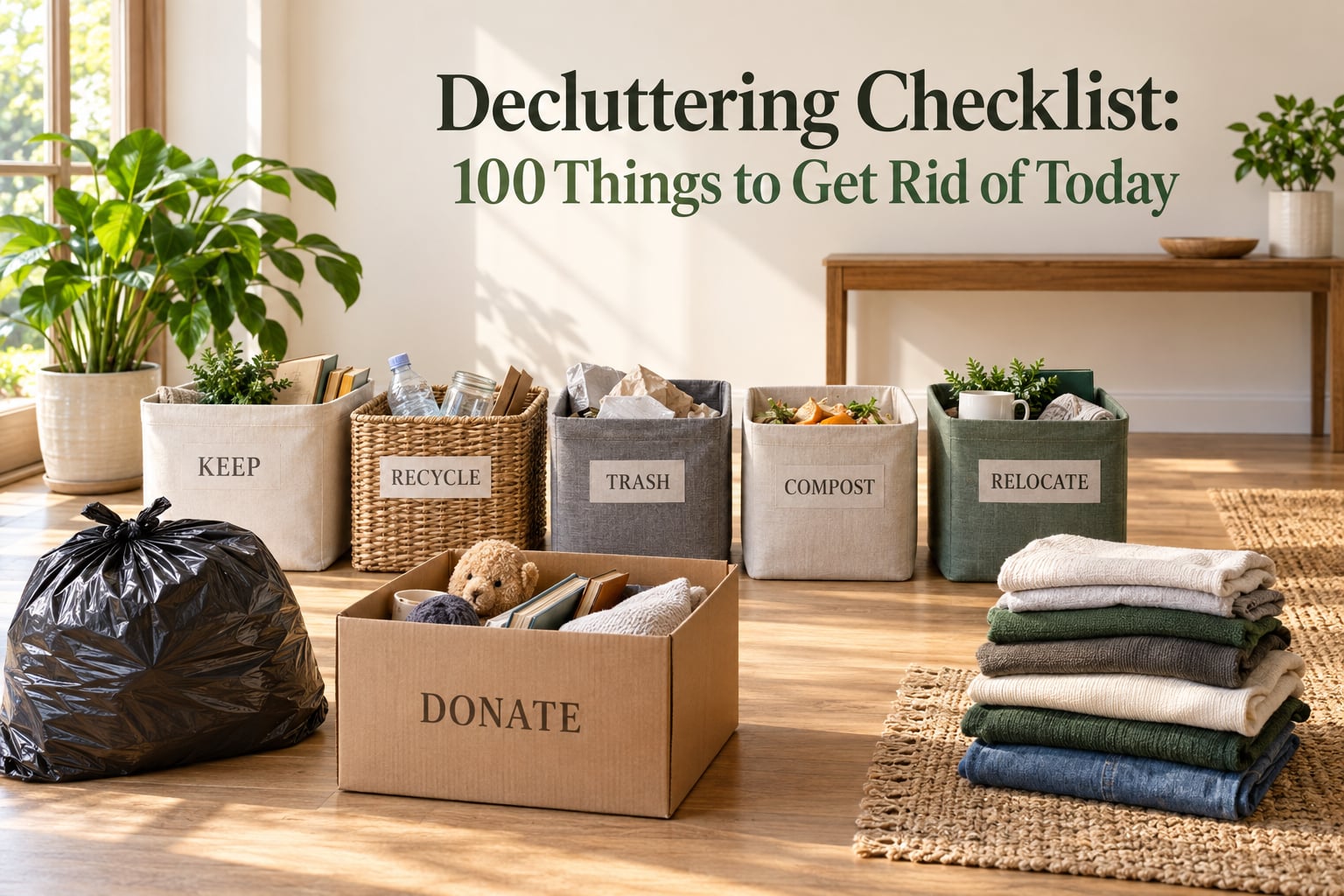
A decluttering checklist works because it replaces one agonizing decision at a time with a fixed list you can work straight down. This one gives you 100 things to get rid of, grouped room by room, each with a short reason and the route it should take out of the house: trash, recycle, donate, sell, take-back, or delete.
Most people who say they have nothing to declutter are describing one room. On r/declutter and r/minimalism, the number 100 consistently sounded impossible right up until it wasn’t, with commenters reporting totals of 200, 500, even a thousand items from a single desk or book corner. People living in 950 square foot apartments hit the mark without any trouble at all.
You do not need a free weekend. Twenty minutes per room is genuinely enough, because the list does the thinking for you. Set a timer, put a bag in one hand and a box in the other, and start at item one.
Updated for October 2026.
Table of Contents
- What You Need Before You Start: Bags, Boxes, a Timer, and Five Sorting Streams
- The Decluttering Checklist: 100 Things to Get Rid of Today
- Kitchen: 10 Quick Wins That Go Straight in the Bag
- Pantry and Food: 10 Items You Can Decide By Date Alone
- Bathroom: 10 Items Nobody Wants to Touch, so You Should
- Closet and Clothing: 10 Items to Donate or Bin Using the 12-Month Rule
- Living Room: 10 Items Hiding in Plain Sight
- Bedrooms, Kids and Linens: 10 Outgrown and Duplicate Items
- Home Office, Paper and Mail: 10 Items That Only Take One Decision
- Electronics, Cords and Chargers: 10 Items to Take Back, Not Bin
- Garage, Storage and Seasonal: 10 Items That Eat the Most Space
- Digital, Car and Outdoor: 10 Items With No Physical Footprint
- Where Every Item Goes: Disposal Routes at a Glance
- Safe Disposal Rules for the Items on This List
- Expired medication never goes down the drain or in the loose trash
- Damaged nonstick cookware is finished, not reusable
- Half-burned candles need to cool and solidify first
- Cords with exposed wire are a fire risk, not donation material
- Ink cartridges and printer waste go to take-back
- E-waste never goes in the curb bin
- How to Get Rid of Sentimental Items and Gifts
- What If You Cannot Find 100 Things to Get Rid Of
- Where to Donate in Edmonton and What to Do With the Rest
- When Someone Else in the House Will Not Declutter
- How to Stop Clutter From Coming Back
- Frequently Asked Questions
- How long does it take to get rid of 100 things?
- Is 100 things a lot to declutter?
- What is the hardest thing to get rid of when decluttering?
- What is the 3-3-3 rule for decluttering?
- What is the 5 5 5 rule for decluttering?
- What are 7 things I should get rid of daily for minimalism?
- What are 50 things I can throw away quickly to declutter my home?
- What can I donate in Edmonton?
- What do I do with stuff I cannot sell or donate?
- How do I get rid of sentimental things?
- Your Turn: One Room, Twenty Minutes, One Hundred Things
What You Need Before You Start: Bags, Boxes, a Timer, and Five Sorting Streams
Gather five containers and label them with a marker before you touch a single drawer. Labeling first is the difference between a 20-minute session and a 20-minute session you abandon halfway through, because an unlabelled box turns every item into a fresh decision.
The five sorting streams are the whole method. Everything you pick up goes into exactly one of them, and nothing sits on the floor waiting for you to make up your mind later.
- Trash for anything broken, soiled, or genuinely useless.
- Recycle for clean paper, cardboard, glass, metal, and rigid plastic that your local program accepts.
- Donate for anything in good, working, clean condition.
- Sell or pass on for higher-value items, priced and listed within 30 days or the item moves to donate.
- Take-back, shred, or delete for medication, electronics, ink, personal documents, and digital accounts.
Keep is the sixth option, and it is the one to use most sparingly. If an item survives a genuine test, it stays. Otherwise it travels.
The 20-Minute Per Room Plan
One room, 20 minutes, timer running. The timer matters more than the room, because a stopped timer is how a 20-minute job becomes a 3-hour emotional project nobody enjoys.
- Minute 0 to 2: set the timer and place the five containers in the room’s centre.
- Minute 2 to 7: surfaces first, counters, tabletops, and visible areas, because visible clutter drives the rest of the decisions.
- Minute 7 to 16: one drawer or one shelf at a time. Take everything out before deciding on anything, since half-empty drawers hide the worst offenders.
- Minute 16 to 20: bag and box it, walk the donation box out, and stop even if the room is unfinished.
Do not organize while you purge. Putting a fresh stack of matching bins around items you have not yet decided about is the most common way a declutter session turns into a shelving project. Decide first, organize later, or not at all.
The Decluttering Checklist: 100 Things to Get Rid of Today
Here is the full list, 100 items across 10 categories, numbered continuously so you can track your count. Each line is a decision you should be able to make in seconds.
Kitchen: 10 Quick Wins That Go Straight in the Bag
- Empty water bottles and juice bottles in the recycling bin.
- Expired condiments and open hot sauce past its date.
- Takeout menus, dozens of identical copies.
- Old chipped mugs you never reach for.
- Plastic bags stuffed in a drawer, folded for reuse or binned.
- Dead batteries from remotes, toys, and flashlights.
- Old cookbooks you cook from a screen anyway.
- Reusable containers missing a lid.
- Old cutting boards with deep scoring or splits.
- Paper towels and tissues from the junk drawer pile.
Pantry and Food: 10 Items You Can Decide By Date Alone
- Expired canned goods from the back of the shelf.
- Spices past the last date, and open spice jars you never cook from.
- Flour, sugar, or rice that has gone stale or bugged.
- Half-open bags of baking ingredients used once.
- Dried fruit and nuts that have been open more than a few months.
- Opened oil that has gone dark or smelled off past a few months.
- Duplicate breakfast items, three boxes of the same cereal.
- Bottled sauces with more than one unopened in the cupboard.
- Freezer burn packages nobody is going to cook.
- Drink boxes and juice pouches past their date.
Bathroom: 10 Items Nobody Wants to Touch, so You Should
- Makeup past its 12 to 24 month window.
- Expired sunscreen, which loses protection long before it looks odd.
- Old razors and blades that have dulled.
- Half-empty bottles of shampoo and lotion you will never finish.
- Grimy hairbrushes with hair wound into the bristles.
- Fragrance samples and sachets from calendars several years old.
- Toothpaste tubes rolled up from the bottom and nearly empty.
- Nail polish gone thick and stringy.
- Old loofahs and exfoliating gloves past the month mark.
- Cotton swabs, cotton rounds, and dried-up nail polish brushes.
Closet and Clothing: 10 Items to Donate or Bin Using the 12-Month Rule
- Clothes you have not worn in 12 months.
- Holey socks with no matching partner.
- Shoes that pinch, blister, or have lost their shape.
- Underwear and socks with elastic gone slack.
- Jewelry you have not worn in a year.
- Handbags and totes stored for years and never used.
- Belts that no longer fit your current waist.
- Clothing kept only because it was expensive.
- Shirts and blouses that do not fit after weight change.
- Scarves, wraps, and winter accessories you never reach for.
Living Room: 10 Items Hiding in Plain Sight
- Magazines from last year, stacked and unread.
- Takeout menus and flyers stuffed in the side table.
- Old board games missing pieces or cards.
- Remote controls for televisions and players you no longer own.
- Old VHS tapes and the player that only reads them.
- Candles that have never been lit, or have burned down to a stub.
- Charging cables for devices you replaced years ago.
- Coasters, trinkets, and free swag from places you no longer visit.
- Decorative storage boxes that are empty and store nothing.
- Spare picture frames with no photo in them.
Bedrooms, Kids and Linens: 10 Outgrown and Duplicate Items
- Kids clothes two sizes outgrown.
- Toys for interests nobody in the house has any more.
- Outgrown shoes with no room left for the next size.
- Books the children have outgrown and reread free at the library.
- Duplicated plastic toy sets missing their lids.
- Extra twin sheets and pillowcases you never use.
- Pillows that have lost their shape.
- Beach towels that have gone scratchy and thin.
- Naked baby items from outfits your child has outgrown.
- Old hair ties crusted with product, plus a take-back bag for salons.
Home Office, Paper and Mail: 10 Items That Only Take One Decision
- Old bank statements and bills older than seven years.
- Receipts you kept for a purchase you no longer need a return window for.
- Expired warranties and registration cards.
- Manuals you have never opened, searchable online instead.
- Envelopes you kept for a reason that never arrived.
- Business cards of businesses that closed years ago.
- Junk mail, unopened for a full year.
- Duplicate home office supplies, three of the same stapler.
- Old tax returns beyond the retention window you need.
- Saving recipes clipped from magazines years ago.
Electronics, Cords and Chargers: 10 Items to Take Back, Not Bin
- Old phones with a cracked screen and no plan for the data.
- Laptops and tablets too slow to be useful.
- Single headphones, missing a mate or a case.
- Cords and adapters for devices you no longer own.
- Old digital cameras and camera bags.
- Empty printer ink cartridges, boxed for take-back.
- Dumb routers and modems your provider retired.
- Old phone cases from devices you no longer carry.
- Cable boxes full of adapters for one forgotten device each.
- Broken small appliances, from kettles to toasters.
Garage, Storage and Seasonal: 10 Items That Eat the Most Space
- Seasonal decor you have not put up in two years.
- Christmas decorations missing pieces, in a box that lives in the garage.
- Duplicate holiday serving dishes you only use once a year.
- Storage bins that are empty but occupy a whole shelf.
- Camping or sports gear unused since the last season.
- Old suitcases that cannot zip or have lost their wheels.
- Paint tins from a colour you have repainted twice.
- Tools rusted through or bought for a one-off job.
- Luggage and coolers from trips you have no plans to repeat.
- Old furniture or shelving the family has replaced.
Digital, Car and Outdoor: 10 Items With No Physical Footprint
- Subscriptions you forgot you were paying for.
- Unused apps on your phone, deleted in batches.
- Old photo duplicates clogging your camera roll.
- Playlists and saved videos you never reopen.
- Old email accounts you no longer check.
- Gym memberships and loyalty programs you stopped using.
- Old files on your laptop desktop, moved off it.
- Receipts and wrappers littering your car floor.
- Car emergency gear that expired, like old tire inflator tubes.
- Garden tools rusted through and patio furniture with split cushions.
If you have ticked 50 already, you have more than answered the PAA question about what can be thrown away quickly. The fastest wins in the whole list are expired food, paper, single socks, magazines, takeout menus, and dead batteries.
Where Every Item Goes: Disposal Routes at a Glance
No competitor on this search offers a per-item route, which is why readers finish a 100-item list with a pile on the floor and no idea what to do next. Here is the routing table that closes that gap.
| Item group | Route | Note |
|---|---|---|
| Expired food, spoiled pantry items | Compost, then municipal green bin | Cut the bags open so animals cannot get in |
| Glass bottles and jars | Glass recycling | Never in the curb bin, even in most programs that say they take it |
| Paper, cardboard, junk mail | Blue cart or municipal paper bin | Shred anything with your name and number on it first |
| Empty plastic bottles and jugs | Curbside recycling | Rinse, cap back on, no food residue |
| Clothing, shoes, linens, towels | Donation depot, textile bin, or Buy Nothing | Only if clean and wearable; rags go to a textile recycler |
| Books, CDs, DVDs, board games | Donation depot or library sale table | Milky discs, cracked cases, and missing-piece games get recycled or binned |
| Small working electronics | Donate, or manufacturer take-back | Wipe your data first, every time |
| Printers, monitors, TVs, phones, batteries | E-waste take-back depot | Never in the curb bin; these carry heavy metals |
| Prescription and over-the-counter medication | Pharmacy take-back program | Never flushed, and never loose in the trash unless the pharmacy says so |
| Used oil, paint, solvents, propane cylinders | Hazardous waste collection or eco depot | Separate from everything else, no exceptions |
| Damaged nonstick pans, unknown cookware coating | Trash, wrapped so nobody cuts themselves | Once the coating flakes, the pan is done |
| Partly burned candles and lighter fluid | Trash or hazardous waste | Let wax cool completely and solidify first |
| Cords with exposed or chewed wire | Trash, cut up | Fire risk, and not something a donation centre will take |
| Documents with personal data | Shred, not recycle | Cross-cut if it is tax or medical paperwork |
| Subscriptions, apps, accounts | Cancel and delete | Check for a free trial that renewed, a common hidden cost |
Safe Disposal Rules for the Items on This List
Most of this list is ordinary household waste, but a small group of items on it can hurt people or contaminate a load of recycling if you treat them like the rest. Read this section before your first bag is full.
Expired medication never goes down the drain or in the loose trash
Take prescriptions and over-the-counter medicines to a pharmacy take-back program. Many Edmonton pharmacies host a drop-off bin, and Alberta also runs drug take-back days at larger sites, which is the right route for anything that leaked or was stored long past its date.
Damaged nonstick cookware is finished, not reusable
Once a nonstick pan’s coating is flaking, scratchy, or rusting through to the metal underneath, throw it away rather than cooking on it. Wrap the pan in tape or a bag before binning it so nobody in the recycling stream slices themselves on the edge.
Half-burned candles need to cool and solidify first
Never pour hot wax down a drain. Let the remaining wax cool and harden in the container, then bin the whole thing. Lighter fluid and any solvent-based cleaner belong with hazardous waste, not the kitchen sink.
Cords with exposed wire are a fire risk, not donation material
Cut the plug end off any cable with nicked, chewed, or exposed wire and bin it. This is also the moment to check the smoke detector batteries, since a dead battery in a detector is the single most avoidable hazard in a winter Edmonton home.
Ink cartridges and printer waste go to take-back
Empty ink cartridges contain residue that does not belong in recycling. Most office supply stores and library copy rooms take them back for recycling. Large printers, monitors, and scanners need an e-waste site instead.
E-waste never goes in the curb bin
Phones, batteries, cables, and small appliances all qualify. Wipe every device before you hand it over, and remove any SIM or memory card, because recycled electronics can end up in a landfill if the data is still readable.
How to Get Rid of Sentimental Items and Gifts
The hardest thing to get rid of is almost never the trash. It is the box of cards, the children’s drawings, the inheritance, and the gifts you were given by someone who would be hurt if you binmed them.
For objects with real attachment, use a photograph. A single printed photo of a handmade blanket or a first guitar takes up a fraction of an inch and keeps the memory intact. People in r/simpleliving report this is the moment the decision finally makes itself.
For gifts, the giver’s feelings have already been honoured by the fact that you received it. Donating it keeps it in use, which is a better outcome for the object and for them than a lifetime in a closet.
For an inheritance nobody wants, siblings often disagree, so agree on one shared decision before anyone moves anything. A family group chat with a firm deadline beats a year of polite hesitation.
For the never-opened gift or hobby that never happened, set it free without guilt. The 12-month rule applies here too, and it applies to commitments as much as to clothing.
What If You Cannot Find 100 Things to Get Rid Of
You do not need 100. The number is a device for making progress visible, not a quota, and treating it as a quota is the fastest way to end up keeping a bag of trash in the garage for three weeks.
If you want a 25-item version, take the 25 zero-regret lines from this list: expired food, empty bottles, junk mail, takeout menus, magazines, single socks, dead batteries, old receipts, mismatched containers, worn-out undergarments, and the rest. None of these involve a memory or a conversation with anyone.
If you want a 10-item version for a 20-minute window, do this: one junk drawer, one pantry shelf, one bathroom cabinet, and the coat closet. Commenters who run this short version on a nightly timer report it becomes the habit that changes the whole house within a month.
If you genuinely have almost nothing, your home is already tidy and this is the wrong article for you. Look instead at what is coming: a move, a new baby, a downsizing, or a seasonal change is when a 100-item list becomes useful.
Where to Donate in Edmonton and What to Do With the Rest
Edmonton has several donation depots that accept household goods, textiles, and small working appliances, and most of them run free clothing bins too. The rule that catches people out: a depot takes items in good condition only, and anything soiled, broken, or missing parts gets refused, which is how the same carload comes home twice.
For clothing, textiles, and small household items in decent shape, the clothing bins and Buy Nothing groups are the fastest route, and they are free. Give Nothing Edmonton and similar local groups are useful for items in good shape that will not fit in a bin.
For recycling, the City of Edmonton’s curbside program and the city’s recreation centres and libraries, which host bottle-deposit return stations, cover a lot of ground. For everything else, eco depots and the city’s hazardous waste collection take paint, solvents, electronics, batteries, and used oil, and those items have no curbside route at all.
Two practical notes from people who have done this many times. Book a depot drop-off the week your box is full, because donation centres get busy and a full donation box that sits in your hallway for three weeks becomes part of the problem. And if a door-to-door pickup no-shows twice, stop trying, because a donation bin is never a long-term answer for more than about two rooms’ worth.
For anything a donation centre or pickup will not take, thrift and consignment stores buy items outright, which turns clutter into a little money rather than a trip to the dump.
When Someone Else in the House Will Not Declutter
The most common comment on decluttering posts is not about the writer’s own stuff. It is about a partner’s boxes, still unpacked from a move years ago, or a garage belonging to someone else entirely.
Start with your own zones and do not negotiate the rest. Decluttering your side consistently changes how the rooms look, and rooms that look better get used more, which is often more persuasive than being right.
When you do raise it, make it about a shared problem rather than their character. “The hallway cannot take a laundry basket” lands better than “your boxes are in the way.”
With kids, turn it into a game and count boxes out loud. One parent reported a toddler clapping and yelling yay at every filled box, and the whole household finished in an hour.
For one person’s collection that the whole family has agreed to preserve, a labelled bin gives the objects their own real home instead of a permanent corner of yours. That bin can stay full for years without costing anyone daily peace of mind.
How to Stop Clutter From Coming Back
One weekend of decluttering only matters if the pile does not reform by Christmas. The three habits that hold are small, and two of them take fifteen minutes a day.
One in, one out. When something new comes in, one thing goes out. This works for clothes most reliably, because it converts the endless re-buying into a rule rather than a decision.
A 15-minute nightly reset. Kitchen counter, one surface, shoes by the door, the fridge door. A timer and a fixed list of four zones. The reason clutter returns is that no single task is ever urgent enough to do, so bundle four small ones into a 15-minute appointment.
Never move empty-handed. Readers report sticking to this one for years: every time you go up or down the stairs, carry either something to put away or something to remove. Two trips, ten seconds each, no decision required.
Add a seasonal mini-declutter of 30 minutes at each change of season, aimed at clothes, decor, and gear that only appears once a year. Readers who run this pattern report that the seasonal purge takes about 30 minutes because the piles are so small.
A permanent give box near where you unpack deliveries makes the decision before the item reaches the pile, which removes the whole point of friction.
Frequently Asked Questions
How long does it take to get rid of 100 things?
Set a timer for 20 minutes per room and work five rooms and you have cleared 100 things in about 100 minutes, plus a short walk to drop off the donation box. The list is what makes it fast, because you are not making a fresh decision for every object. One commenter cleared well over 100 items from a single desk corner in under an hour.
Is 100 things a lot to declutter?
Not for most homes. People who called 100 impossible on decluttering forums routinely reported totals of 200, 500, or more, and renters in 950 to 1000 square foot apartments hit the number easily. The people who struggle are not cluttered, they are just tired. Treat 100 as a starting target rather than a rule.
What is the hardest thing to get rid of when decluttering?
Sentimental objects and gifts beat trash every time, because trash carries no emotional weight and gifts carry someone else’s expectations. Photographing the object, donating it while it is still useful, or setting a family decision deadline for an inheritance all release it faster than a willpower argument. The 12-month rule is useful here because it removes the decision from your hands.
What is the 3-3-3 rule for decluttering?
The 3-3-3 rule suggests keeping three of something, donating three, and keeping three more, or a variation that moves 30 percent of a category out each time. Popularity for it varies, and it is fiddly to apply to a junk drawer. Our version of the same idea is the one in, one out rule, which is easier to keep forever.
What is the 5 5 5 rule for decluttering?
The 5 5 5 rule means keeping five years of past items, five years ahead, and five percent of your current budget, and applying it to purchases rather than to existing clutter. It is a spending rule, not a decluttering one. Use it to slow new purchases and one in, one out to handle what you already own.
What are 7 things I should get rid of daily for minimalism?
Pick the seven fastest, lowest decision items: junk mail, takeout menus, expired pantry items, empty bottles, single socks, old receipts, and dead batteries. They take about 15 minutes in total, which is exactly the size of the nightly reset. Readers who run this daily say it is the habit that stops the pile from ever rebuilding.
What are 50 things I can throw away quickly to declutter my home?
Take the first 50 items on the list above, which are all kitchen, pantry, and bathroom items decided by date or by condition alone. None of them involve a memory, a gift, or a conversation, which is why they clear fastest. Zero-regret trash like this builds the momentum for the harder decisions later.
What can I donate in Edmonton?
Edmonton donation depots take clothing, shoes, linens, books, toys, small working appliances, and household goods in clean, working condition, and most run free textile bins. Recyclables, electronics, batteries, paint, and solvents go to eco depots and hazardous waste collection instead. Anything soiled or broken will be refused, so sort it before you load the car.
What do I do with stuff I cannot sell or donate?
Break it into categories. Broken or soiled items go to trash, with sharp edges wrapped. Clean paper, cardboard, glass, and metal go to the right recycling stream. Electronics, batteries, ink, and medication need a take-back or eco depot. If it is bulky and useless, ask about curbside bulk pickup rather than moving it around the house again.
How do I get rid of sentimental things?
Photograph what you cannot part with and keep the photo instead of the object, since it takes up almost no space and holds the memory. For gifts, donating them keeps the object in use and honours the giver better than storage does. For an inheritance the family is arguing about, set one shared deadline in a group chat so nobody has to decide alone.
Your Turn: One Room, Twenty Minutes, One Hundred Things
A decluttering checklist only works if it ends in a decision, so here is the whole thing in one line: set out five labelled containers, set a 20-minute timer, and work the 100 items above room by room without organizing anything you have not yet sorted. Most people reach 100 in five rooms, and the ones who do it at night for 20 minutes a day keep the house clear for good.
Take the photograph of the one object you know you will agonise over, put it on the donation pile, and get out the bags. If you want the printable checkbox version of this list, it is the fastest thing you can set up before you start.