
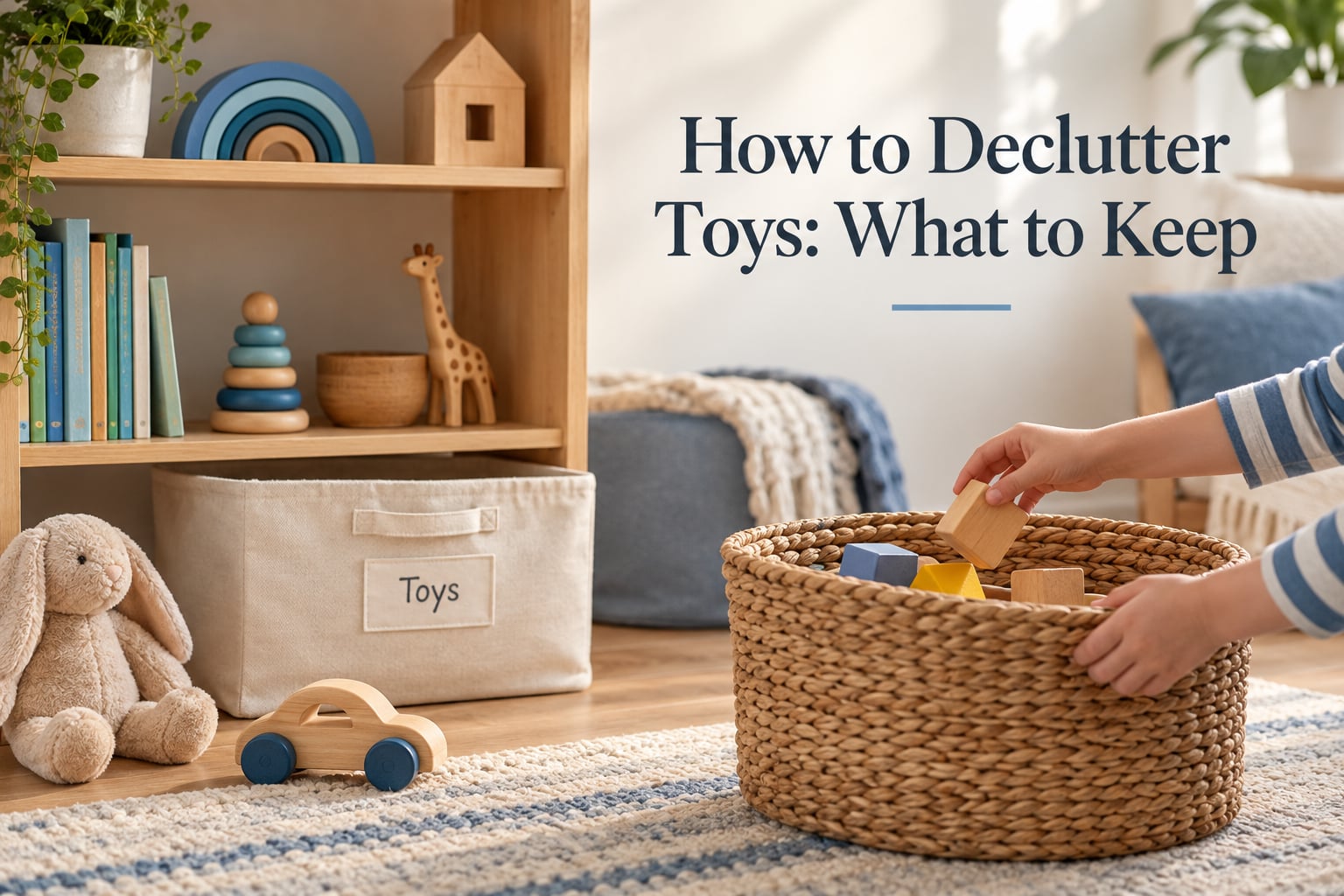
If you want a straight answer before anything else, every toy in your house belongs in one of four piles. Keep the toys your child chooses to play with on repeat, Rotate the ones they enjoy but only reach for sometimes, Donate or sell the ones that have not been touched since they outgrew them, and Trash anything broken, missing pieces, or held together with tape. That is the whole method. The rest of this guide is how to sort fast without a meltdown.
Most families do not have a storage problem. They have a decision problem. The closet is full, the living room floor is a carpet of building bricks, and nobody can say which of the four bins the clean Duplo tub belongs in. Learning how to declutter toys is less about throwing things away and more about putting each toy in a named place on purpose.
I have sorted through enough of these to know where parents get stuck. It is almost never the volume of toys. It is the moment a child fixates on the one item you put in the donate pile and suddenly it is their most treasured possession in the world. This guide gives you a decision test that takes ten seconds per toy, a per-category cap so you are not guessing, and a realistic time budget so the job actually finishes.
Table of Contents
- Why toy clutter is worth fixing
- The four-destination sort: what to keep, rotate, donate or trash
- How to declutter toys in six steps
- Start with the easy wins
- What to keep by category
- How to rotate toys when you have no storage space
- Sentimental toys: the memory box method
- How to get your kids to declutter toys with you
- How to stop toy clutter from coming back
- What to do with the toys you remove in Edmonton
- When is the best time to declutter toys
- Frequently Asked Questions
- What is the 20 toy rule for kids?
- What is the 5 5 5 rule for decluttering?
- What is the 12-12-12 rule for decluttering?
- How do I categorize toys for rotation?
- How does the Montessori method organize toys?
- How to get kids to declutter toys?
- What is the hardest thing to get rid of when decluttering?
- How many toys should a child have?
- A calmer playroom starts with one sorted category
Why toy clutter is worth fixing
Too many toys do not make a child play more. They make a child pick less, because a full shelf turns every play session into a search.
One organising blog that tracks this puts the average child at somewhere near 238 toys owned against roughly 12 in regular use. Whatever the exact count, the pattern is the one parents describe in forum threads again and again: a child plays with a small fraction of what they own, and pulling something out of the discard pile makes it suddenly precious.
There is a money side too, and it stings. Families on a budget feel it hardest. The toys that never leave the bin are the same toys that came home in a December haul and were opened, carried to the playroom once, and absorbed into the general clutter. Decluttering is how you stop paying for the same category twice.
And then there is the nightly tax. Thirty minutes of cleanup a day is two full hours a week spent putting away things nobody played with. Cut the pile and the cleanup gets shorter by itself.
The four-destination sort: what to keep, rotate, donate or trash
Sort every toy into one of four destinations, and the decision stops being personal. Here is the test to run on each item.
| Destination | The signal that sends a toy here | Examples | What you do next |
|---|---|---|---|
| Keep out | Played with weekly, or named unprompted in the last month | Current favourite book series, the doll they sleep with, the one big build set | Stays on an open shelf within reach |
| Rotate | Loved, but only touched every few months, or seasonal | Summer water table, winter craft kits, seasonal puzzle boxes | Label and date the bin, swap it out on a schedule |
| Donate or sell | Not touched since it was outgrown, or one of several duplicates | Push cars, clothes and shoes your child has outgrown, duplicates of a set you kept | Out of the house within one week, not parked in a corner |
| Trash | Broken, missing pieces, recalled, or held together with tape | Batteries corroded, puzzles missing a corner, one glove | Recycle what can be recycled, bin the rest |
The distinction that trips up almost every parent sits between rotate and donate. Not played with this month means rotate. Never liked means donate. If the toy sparks play in a child, it is resting, not unwanted.
That specific line is worth repeating, because it is the single most common confusion in toy decluttering. Adults treat a dusty toy as dead, and children treat a dusty toy as waiting. The Quarantine Box test settles it: put a questionable toy in a labelled box, put the box somewhere out of sight, and give it a month. If nobody asks for it, it goes to donate. Families report this works far better than arguing in the moment.
How to declutter toys in six steps
Work one category at a time and finish in a week rather than a heroic weekend. The order below is deliberate: the easy wins come first so you build momentum before the hard decisions.
Step 1: Watch for one week
Do not touch anything. For seven days, note which toys your child actually walks over to. Put a sticky note on each one, or photograph the floor each evening before you clean up. This is the step people skip, and skipping it is why they keep the wrong things. Parents often find the list of weekly favourites is far shorter than the playroom suggests.
Step 2: Gather everything into one place
Pull toys from under the bed, the mudroom, the garage, the car, the closet shelves. Every toy needs to be in the room at the same time or the sort is a lie. In an Edmonton winter, the garage and mudroom are the usual hiding spots, and basement shelves collect toys that nobody has seen since the last move.
Step 3: Sort by category, not by pile size
Group them into soft toys, building toys, dolls and figures, arts and crafts, games and puzzles, vehicles, pretend play, and baby toys. Work one category at a time and finish it. Sorting everything into four boxes at once leaves you flipping through a mountain for three hours and quitting.
Step 4: Make the four piles
Four labelled containers: Keep, Rotate, Donate or Sell, Trash. Keep the donate container outside the room if you can, so the pile you are not allowed to raid is also the pile you cannot argue about.
Step 5: Decide, using the cap for that category
Pick a number for the category before you start sorting, and hold the line. The cap table below gives you starting numbers. A child who genuinely loves twelve of thirty stuffed animals gets to keep those twelve. Wiggle room above the number is fine; no number at all is how the pile came back.
Step 6: Let go, and set a deadline
Bag up the donate pile and get it out of the house within a week. A donation bag in the corner for three months becomes a donation bag in the corner forever, and the sort was wasted. For the money-back items, list them the same evening while you are still sorting.
Give yourself about 20 minutes per category. Eight categories is under three hours spread across a week, and that is a finishable budget for a family with school-age kids.
Start with the easy wins
Start with the toys that need no judgement call, because finishing them quickly makes the rest feel doable. These are not decisions, they are clear-outs.
- Broken toys. Anything snapped, cracked, or glued back together goes to recycling. A patched toy is not a memory, it is a sharp edge waiting to happen.
- Missing-piece sets. A puzzle with a gap or a set missing one block teaches frustration, not play. Parents with a lot of these usually have one large donation bag appear in a single afternoon.
- Duplicates. Three of the same toy, four identical trucks, two copies of the same board game. Keep the best condition, donate the rest.
- Packaging and instruction manuals. Toss the boxes. If the instructions matter, photograph them, because a manual in a drawer is never opened.
- Fast food and party favours. Give these a 24-hour lifespan. They were never playthings, they were marketing, and they are the easiest win in the house.
- Outgrown baby toys. Once a child is walking steadily and climbing, the highchair and jumper toys have a short life. These move out first, not last.
Wipe down batteries before they go anywhere. Corroded batteries in a donated toy are a safety problem for whoever opens the box next, and they rule out the whole bin at most donation centres.
What to keep by category
Use these caps as a starting point, not a law. The magic number technique works because the number is decided before the emotion starts.
| Category | Keep roughly | Rotate rather than keep | Watch for |
|---|---|---|---|
| Soft toys and stuffed animals | 10 to 12 | Seasons, animals, anything tagged for a sleepover | Wash or bag them; hygiene rules out most soft toy donation |
| Building toys | 1 to 2 large sets plus 1 bin of loose pieces | Duplicate kits of the same theme | Keep every loose brick; a set with no small pieces stops working |
| Dolls and action figures | 1 bin or one shelf | Series figures collected rather than played with | If the figure is never used in play, it is a collection, not a toy |
| Vehicles | 1 bin, mixed types | Seasonal sets such as a racetrack or farm | Loose wheels and axles break and end up in feet |
| Arts and crafts | 1 caddy of consumables plus 1 kit bin | Regiftable craft sets, seasonal decorations | Crayons and playdough cost nothing to replace and clutter nothing |
| Games and puzzles | Age range plus 1 to 2 ahead | Games above the current age band | Check every puzzle and game box has all pieces before keeping |
| Pretend play and dress up | 1 bin, in rotation with real clothes | Costumes for a party that already happened | Check for adult sizing before keeping |
| Baby toys | 0 once outgrown | Rattles and teethers once solids start | Battery and button-cell safety before anything leaves |
Open-ended toys earn their space faster than closed ones. Blocks, magnetic tiles, a plain blanket fort kit, and role-play props change shape every week. A single-purpose electronic toy usually does one thing, once, and then joins the shelf.
You will also hear the KonMari phrase for this. If your child is holding a toy and feels nothing, that is useful information, and it is reasonable to let it go. But sparks joy is a clothes rule, and toys are a different problem, which is why a cap per category works better here than a feeling test alone.
How to rotate toys when you have no storage space
Toy rotation is the practice of splitting your toys into two sets and alternating which set is out. It works because a smaller visible selection produces more play, and because a child who has not seen a toy in eight weeks treats it as new.
Most families do not need a playhouse. They need a plan that works in a two-bedroom Edmonton home with no basement storage worth using.
- Split by category, not by count. Half the building toys out, half in one lidded bin. Half the puzzles out, half stored. Children rarely miss a specific duplicate when the category itself is still there.
- Label and date the bin. Write what is inside and when it went in. Unlabelled bins become the storage overflow nobody revisits.
- Swap monthly, not daily. A monthly rhythm is easy to keep. A weekly rotation is a chore that ends in week three.
- Use the Quarantine Box instead of a rotation when space is tight. One box, labelled with a date, doubles as your test for whether a toy is still wanted.
- Keep shelves open and part-empty. Leave room in every bin so a child can see what is in there and put things back themselves. Overfilled bins get ignored, and an ignored bin is clutter you moved instead of removed.
The Montessori approach runs on the same principle: display a limited, orderly set of materials on open shelves at child height, swap the display rather than the storage, and keep everything else out of sight. Nothing decorative goes on the shelf. If a child cannot reach it and see it, the shelf is not doing its job.
A workable math for the first pass: cull a category by half, then cut that half by half again. Four of something becomes one. That aggressive second cut is what makes rotation possible in a small space, and it is the step most people skip because the first pass already felt like enough.
Sentimental toys: the memory box method
Sentimental toys get their own method because the normal rules fail on them. Photograph the toy, write the date and a line about why it mattered, and let it go. A printed photo in a memory box holds the memory, and the memory is what you were actually keeping.
Keep the memory box strictly limited. A first birthday outfit, one plush from a hospital stay, a holiday card, a small photo album. Everything else in the box is permission, not obligation.
For the hard one, the hardest thing to get rid of when decluttering is usually a single item your child has not touched in three years but you remember clearly. If you cannot decide in under a minute, photograph it and donate it. You are not throwing away the memory. You are moving where it lives.
Permission for imperfect rules: if your child will not release a particular set, let them keep it. A house with one lovingly kept set is not a failure. The goal is fewer toys and calmer shelves, not a perfect shelf.
How to get your kids to declutter toys with you
Children resist giving toys up because adults take them away, not because they care about the toy. Give your child the choosing power and the resistance drops sharply. Families who set a cap and let the child pick the specific items to release report far less pushback than families who simply announce the plan.
- Start with a category they do not care about.Dolls, or cars, or a bin of seasonal stuff. Never open with the plush animals.
- Name the number first.Ten stuffed animals, and they choose which ten. The number is the rule, not your taste.
- Let them hold the toy for one evening.If they still want it the next day, it stays. One evening is enough to end most arguments.
- Give them a real job.Carrying bags to the vehicle, matching picture labels to bins, testing that puzzle boxes are complete. Children engage when the task has an outcome.
- Explain where the toys go.Children worry about abandonment as much as you do. Say the donate bag is going to a family’s playroom, and mean it.
- Say the word resting, not giving away.Rotated toys are resting. Donated toys are gone. Using the right word for each pile prevents most of the drama.
Expect the attachment flip. The toy you have not mentioned for an hour is the one that becomes precious the moment it hits the donate pile. Treat that as a normal human reaction rather than a failure on your part, and keep sorting.
How to stop toy clutter from coming back
The cleanest declutter is the one you do not have to repeat. Once the sort is done, four habits keep it from rebuilding over the next year.
One in, one out. A new toy means one toy goes. This works best when it is automatic and applies to every category, including the big Christmas haul. Some families set a hard limit of one gift per birthday and ask relatives in advance, which saves the argument in December rather than in the playroom in January.
Set a gift boundary out loud. Grandparents who keep buying are almost never trying to cause clutter; they want to give something the child loves. A short script helps: ask for books, consumables, or an experience instead of toys, and say plainly that your house is at capacity. Parents who have this conversation before December say it is far easier than the alternative.
Buy the non-cluttering kind. Crayons, playdough, sticker books, a craft caddy, a novel, a board game that replaces one you already own. Consumables get used up and leave nothing behind. On a budget, these stretch further than plastic toys and do not need storage.
Run a five-minute daily reset. Everything back to its shelf or bin at the same time each evening. A short reset prevents the pile that makes a big declutter necessary, and it teaches your child that putting things away is a routine, not a chore.
Add a toy exit box by the door. Anything that leaves the house on a donation run goes straight in rather than back into a closet. The container makes removal a five-second decision instead of a project.
What to do with the toys you remove in Edmonton
Donating is the default because it is fast and it costs nothing but a bag. Selling only makes sense for a narrow set of items: brand-name clothing your child has outgrown, well-kept ride-ons, and popular building sets in complete boxes with instructions. Everything else is a time sink.
Before anything leaves the house, run a safety pass. Check for loose or swallowing-size parts, pull batteries out of anything battery-powered, and search for recalls on the brand and model, since recalls are listed by Health Canada and manufacturers. Plush toys usually fail a hygiene check at donation centres, so those go to a charity that accepts textiles or into your own rotation.
For local options in the Edmonton area, check the acceptance policy of the big thrift and charity shops before you load the car, since each sets its own rules on toys, plush items, batteries, and cleaned packaging. Seasonal drive-style toy collections run in the city each year, and schools and community groups often run their own, so a single bag can go further when it lands in a drive than when it lands on a shelf.
For recycling, small rigid plastics and clean cardboard go in your household program. Broken electronics and anything with a battery belong in an e-waste drop-off, not the recycling bin.
Check seasonal timing before you start. Winter is the worst month to sort a playroom and the best month to donate, because donation centres get busier and selective in December. Declutter in February or March instead, and the toys land when there is room for them.
When is the best time to declutter toys
Declutter before the toy influx, not during it. The four moments that work best are a month before a birthday or Christmas, before a house move, before a new baby arrives, and at the end of the school year. Moving and listing a home add a hard deadline that gets things done faster than any amount of motivation.
Winter break is when the pile multiplies, so plan the sort for the new year rather than the holidays. If you are expecting a baby, run the outgrown baby toy clear-out early, because those are easy decisions and they free a bin for the new arrival.
Frequently Asked Questions
What is the 20 toy rule for kids?
The 20 toy rule is a cap, not a formula: show your child no more than 20 toys at a time and put the rest in rotation. It works as a starting point for younger children and as a way to force rotation, but it counts nothing about quality. A single well-chosen open-ended toy counts for more than five plastic ones. Most parents I would point it at use a per-category cap instead, because one number rarely fits stuffed animals, building sets, and puzzles.
What is the 5 5 5 rule for decluttering?
The 5 5 5 rule asks you to keep 5 things you love, 5 things you need, and 5 things you want from each category. It was designed for clothes and household items, not toys, and that mismatch is exactly why parents find it frustrating here. A child does not choose stuffed animals by whether they are useful, and no five things you need in a playroom is a real category. Use it for your own closet, use caps for the toys.
What is the 12-12-12 rule for decluttering?
The 12-12-12 rule means keeping 12 items from each of three categories for 12 months, then re-evaluating. Applied to toys it produces a reasonable seasonal reset, and the 12-month window is its strongest feature because it matches how often a child’s interests genuinely change. The weakness is that 12 months is longer than most families can tolerate with a loose toy bin, so pair it with a monthly rotation instead of waiting a full year.
How do I categorize toys for rotation?
Split by category, not by count, so each child always has the same type of thing available. In practice: half the building toys out and half in one lidded bin, half the puzzles out and half stored, soft toys split into two groups, and seasonal items such as a water table or snow toys rotated entirely. Label and date each bin with its contents, swap monthly, and leave every bin part-empty so a child can see what is inside and put things back.
How does the Montessori method organize toys?
The Montessori approach displays a limited, orderly set of materials on open shelves at child height and keeps everything else out of sight. The display changes rather than the storage, so a child meets a small selection at a time. Nothing decorative goes on the shelf, because a display has to be purely functional to work. For families with no spare room, applying just the out-of-sight principle to a couple of bins gets you most of the benefit.
How to get kids to declutter toys?
Give children the choosing power rather than announcing a plan. Work one category at a time, starting with something they do not care about, name the cap first, then let them pick the specific items to release. Give them a real job such as carrying bags or matching picture labels to bins, and let any toy they still want after one evening stay. Families who set the number in advance and hand over the choice report far less resistance.
What is the hardest thing to get rid of when decluttering?
Usually one item with a strong story attached, often a plush from an early year or a holiday keepsake your child has not touched in years. Photograph it, write the date and a line about why it mattered, and let it go. The photo holds the memory that the toy was standing in for. If you cannot decide in under a minute, that is your answer: photograph and donate.
How many toys should a child have?
There is no magic number, but categories help more than a total. A workable starting point is 10 to 12 soft toys, one or two large building sets plus one bin of pieces, one bin or shelf of dolls and figures, one bin of vehicles, one caddy of craft supplies, and one bin of puzzles within the current age range. One blog puts the average child near 238 toys owned and about 12 in regular use, which suggests most collections are far past the point of useful.
A calmer playroom starts with one sorted category
How to declutter toys comes down to four piles and a number per category. Keep what gets played with weekly, rotate what is loved but idle, donate or sell what has been outgrown, and recycle what is broken. Twenty minutes on one category a night for a week is enough to finish the job.
Start tonight with the easy wins: broken toys, missing pieces, duplicates, and packaging. Get them out of the house, then pick a cap for the next category. Momentum beats motivation, and one cleared bin is easier to start from than a full closet.