
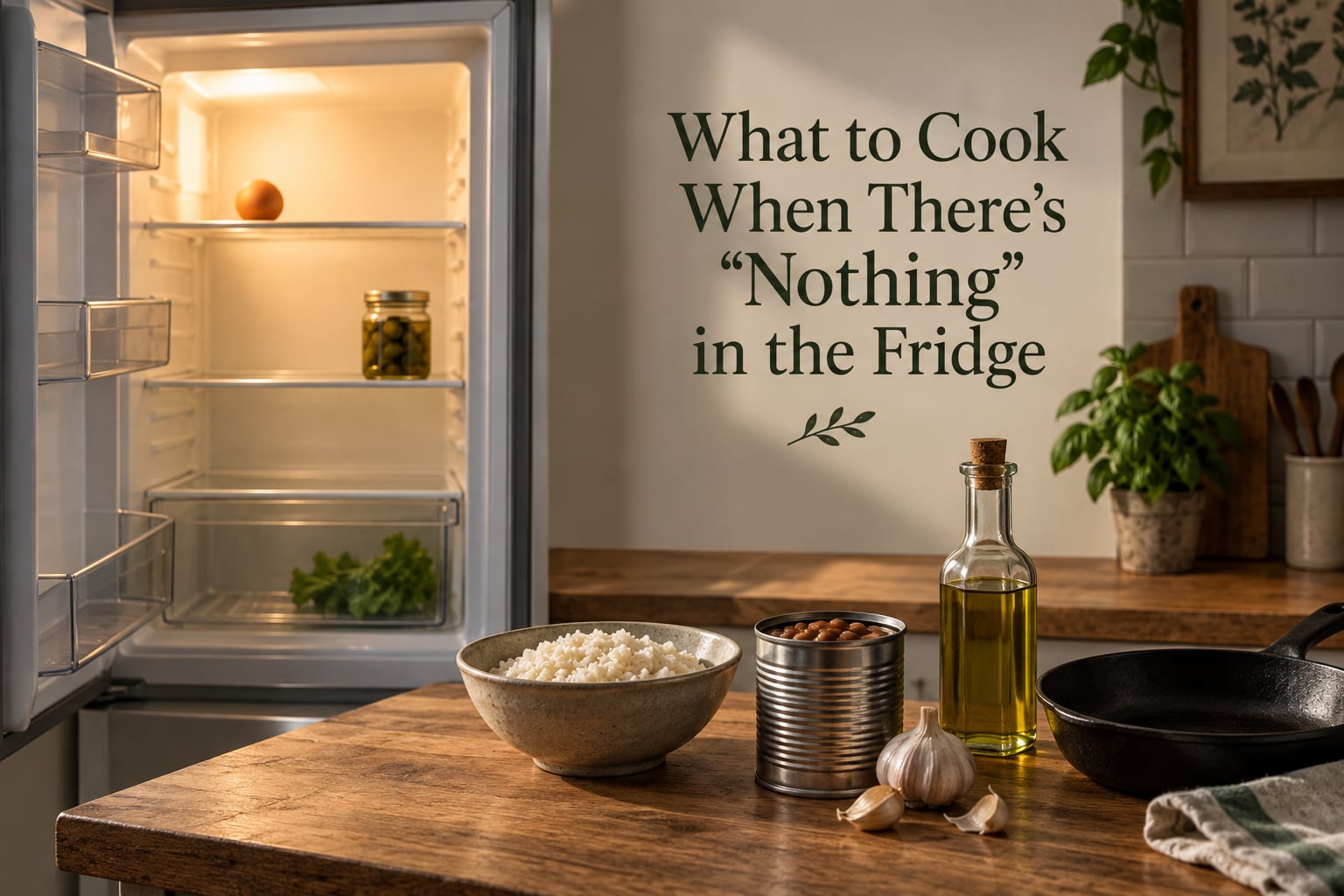
There is a specific moment in every household where the fridge door stays open for a full minute and nothing comes to mind. Not because there is genuinely no food, but because nothing in there is what you want to eat tonight. A commenter on an empty-pantry discussion put it plainly: when the pantry seems empty, it usually means there is no grab-and-go food, just ingredients with nothing made from them.
So this guide starts from the real problem, which is choosing, not stocking. Deciding what to eat is the part that stalls at 5pm, and the fastest cure is a short decision rule you can run in half a minute. Everything below is built around that: what to cook when there’s nothing in the fridge, routed by what you are actually holding, not by what a recipe blog decided you should have bought.
I cook for one adult and two hungry kids in an Edmonton kitchen, and roughly once a week this exact situation shows up. What follows is the decision rule, the meals that come out of it, and the small set of emergency pantry staples that turn an empty fridge into dinner. It is updated for 2026 and framed for a Canadian winter, when the freezer is full and the fresh produce drawer is not.
Table of Contents
- Quick Answer
- What to Cook When There’s Nothing in the Fridge: 12 Fast Meals
- Start With What You Actually Have: The 30-Second Decision Rule
- Meals by What You Have on Hand
- The Three Finishing Moves: Salt, Acid, and Finish-Fat
- 15-Minute, 5-Ingredient Meals
- Meals That Need No Refrigeration
- Cooking for One or Two Without Cooking for Six
- Low-Decision Meals for Low-Energy Days
- The Emergency Pantry Staples Worth Keeping on Hand
- Substitutions: What to Use When You’re Missing the One Ingredient
- Make This Moment Happen Less Often
- Frequently Asked Questions
- What to eat when nothing is in the fridge?
- What can I make for dinner if my fridge is empty?
- What are some good dinner ideas for an empty fridge?
- What meals can I make without a fridge?
- What can I eat that doesn’t need to be refrigerated?
- What food to buy if you don’t have a fridge?
- What are the top 10 foods to stockpile?
- What are some good staple foods to keep in my pantry?
- What two foods never expire?
- What are some easy 15-minute meals that only require 5 ingredients?
- How do people with ADHD cook?
- The One Rule I Fall Back On
Quick Answer
You can make dinner with almost nothing in the fridge. Pick a starch base, add a protein anchor, then finish with salt, acid and a little fat. Pasta, rice or bread plus canned beans, lentils, eggs or tinned fish covers most nights. Add garlic, olive oil and a splash of vinegar at the end and it tastes deliberate rather than desperate.
What to Cook When There’s Nothing in the Fridge: 12 Fast Meals
These are the meals I reach for when the fridge is close to bare. Each one states the total time and the shortest ingredient list that still works. Cost per serving is described in relative terms rather than exact figures, since grocery prices shift week to week.
- Fried eggs on toast with a spoon of whatever sauce is in the door – 10 minutes, 2 ingredients plus salt. Lowest cost per serving on this entire list. This is the most repeated answer across cooking forums: eggs on toast, or a big omelette with whatever is around.
- Pasta with garlic, oil and a splash of pasta water – 15 minutes, 3 ingredients. Low cost per serving. No sauce needed if you emulsify the oil and starchy water with the garlic.
- Canned beans warmed with cumin and a fried egg on top – 12 minutes, 4 ingredients. Low cost per serving and a full serving of protein.
- Rice with soy sauce and a fried egg, rice bowl style – 20 minutes total with 15 of that hands-off, 3 ingredients. Low cost per serving.
- Canned tomatoes simmered down with garlic and vinegar, spooned over toast or rice – 25 minutes, 4 ingredients. Low cost per serving.
- Mujadara: rice, lentils and fried onions – 40 minutes, mostly hands-off. Low cost per serving and it feeds four. A long-standing recommendation in small-kitchen cooking threads for exactly this reason.
- Tinned tuna mixed with mayo or yogurt and spooned onto crackers or bread – 5 minutes, 4 ingredients. Lowest prep time on the list.
- Frozen vegetables dumped into a hot pan with garlic and oil – 12 minutes, 4 ingredients. Low cost per serving, no fresh produce required.
- One-pot rice and canned beans with broth and cumin – 30 minutes, 5 ingredients. Low cost per serving, scales to a family of four.
- Peanut butter on toast with banana or apple slices if you have them – 5 minutes, 2 ingredients. Lowest cost per serving of anything here.
- Cooked chicken or mince shredded into tortillas with whatever sauce is open – 15 minutes. Mid-range cost per serving, but one cooked base feeds several nights.
- Soup from a can of beans or tomatoes plus broth, blended smooth – 25 minutes, 4 ingredients. Low cost per serving and it freezes well in single portions.
The 5pm question is never really which of these twelve, because twelve is still too many. The rule below is what turns the list into a decision.
Start With What You Actually Have: The 30-Second Decision Rule
Run three steps in order and the meal picks itself. First choose your protein anchor, then your starch base, then your finish. Nothing else matters on a night like this.
- Step 1: Protein anchor. Pick one from what exists: eggs, canned beans, dried lentils, tinned fish, canned coconut milk, or cooked meat from last night’s dinner. If you have none of these, go to the pantry shelf, not the fridge.
- Step 2: Starch base. Pick one: pasta, rice, bread, potatoes, tortillas, or oats. This is the part that makes the meal filling rather than a side dish.
- Step 3: Finish. Oil, salt, an acid, and one strong flavour such as garlic, smoked paprika, soy sauce or curry powder. This is what turns three ingredients into dinner.
Anchor plus base plus finish is a complete plate. Nobody at the table can tell there were no fresh vegetables involved, and that is the entire trick.
Use this routing table to jump straight to the right section for what you are holding right now.
| What you have on hand | What it unlocks | Total time | Cost per serving |
|---|---|---|---|
| Eggs | Fried eggs on toast, omelette, frittata, shakshuka-style beans and eggs | 10 to 25 minutes | Lowest |
| Pasta | Garlic and oil pasta, pasta with canned tomatoes, pasta with beans | 12 to 20 minutes | Low |
| Rice | Soy sauce rice bowl, mujadara, one-pot rice and beans, fried rice | 18 to 40 minutes | Low |
| Canned goods | Beans and rice, simmered tomatoes, soup, chili without the meat | 20 to 30 minutes | Low |
| Tinned fish | Tuna on crackers, tuna and egg rice bowl, salmon with rice and vinegar | 5 to 20 minutes | Low |
| Frozen vegetables | Hot pan vegetables, vegetable fried rice, soup, sheet-pan roots | 12 to 30 minutes | Low |
| Cooked meat | Sloppy joe filling, tacos, quesadillas, fried rice, soup | 15 to 25 minutes | Mid-range |
| Condiments only | Fried rice, noodle soup, flatbread, crackers with peanut butter | 5 to 20 minutes | Lowest |
| Literally nothing but a heel of bread | Garlic toast, French toast with powdered sugar, croutons for later | 8 to 12 minutes | Lowest |
Meals by What You Have on Hand
Each of these assumes you have oil, salt and water. Everything else is optional.
Eggs only
Garlic and tomato eggs, 20 minutes. Soft-scramble two eggs in oil with a smashed garlic clove, then stir in a spoonful of canned tomatoes and a splash of vinegar until it looks like a rough sauce. Spoon it over toast. Salt at the end, not the start.
Fridge-clearout frittata, 25 minutes. Any onion half, a handful of frozen peas, the last of a bag of spinach. Whisk eggs, pour over, and finish under the broiler until puffed. One of the few meals that reliably uses the bits nobody wants.
For a picky eater, a plain omelette with salt only, rolled and cut in half, lands more often than you’d think.
Pasta only
Garlic, oil and pasta water, 12 minutes. Boil the pasta in well-salted water. While it cooks, warm sliced garlic gently in olive oil until it is pale gold, not brown. When the pasta is done, move it straight into the pan with a cup of the starchy cooking water and toss hard until the liquid turns glossy and clings. Salt, a crack of pepper, done.
Pasta with canned tomatoes, 18 minutes. Simmer half a tin of tomatoes with a clove of garlic, a spoon of olive oil and a pinch of sugar until it thickens. Drain the pasta, toss it through, and grate whatever hard cheese exists over the top.
The starchy water trick matters more than any sauce. It is free, it is already in your pot, and it makes oil and water behave like a single thing.
Rice only
Soy sauce fried rice, 15 minutes. Cold cooked rice, a hot pan, oil, two eggs beaten in, a spoon of soy sauce, and any frozen vegetable. Press the rice down and let it sit so it toasts before you toss.
Mujadara, 40 minutes, mostly hands-off. Chop an onion and fry it in oil until deeply golden. Add rice, rinsed, and dried lentils with water and salt. Cover, simmer on low for 25 minutes, then let it steam off the heat for 10 more. The onions are the whole dish; do not rush them.
Mujadara is the answer to cooking with almost nothing in a small kitchen. Two shelf-stable ingredients produce four portions.
Canned goods only
One-pot rice and beans, 30 minutes. Rinse half a cup of rice, add a tin of beans, broth or water, cumin, smoked paprika and salt. Bring to a boil, cover, drop to the lowest heat for 18 minutes, then rest 5 minutes untouched. Stir, finish with a spoon of oil and a splash of vinegar.
Bean soup, 25 minutes. Two tins of beans, one tin of tomatoes, broth, whatever root vegetable is softening in the drawer. Simmer, then blend half of it so the soup has body without cream.
Salt in layers, not at the end. Canned goods carry their own salt, so season earlier and lighter than you would for a dish you built from scratch.
Tinned fish only
Tuna and egg on rice, 12 minutes. Drain the tuna well, mix it with a spoonful of mayonnaise or plain yogurt, a squeeze of lemon or a splash of vinegar, and pepper. Serve over hot rice with a fried egg on top.
Hot tinned salmon with vinegar, 10 minutes. Break the salmon into a pan, add a splash of water, cover for 3 minutes, then flake it into a bowl with rice or crackers and dress it with rice vinegar and soy.
Good tinned fish needs draining and a finish far more than it needs a complex recipe. The fish is already cooked.
Frozen vegetables only
Hot-pan vegetables, 12 minutes. Frozen vegetables go into a smoking-hot pan with a glug of oil and nothing else. Do not stir for the first two minutes. Then add garlic, salt and pepper, and toss until the water cooks off and the edges brown.
Vegetable fried rice, 15 minutes. Frozen peas and carrots plus cold rice, an egg, and soy sauce. A frozen bag of mixed vegetables is a perfectly good weeknight dinner once you stop treating it as a side dish.
Frozen vegetables lose nothing nutritionally worth worrying about, and in Edmonton in January they are often the best thing in the house.
Leftovers only
One cooked base, four dinners. Cook a batch of mince or chicken thighs on the weekend. Over the next four nights it becomes sloppy joes, tacos, quesadillas, fried rice or soup, depending only on what you add. This is the oldest answer in the thread record of people cooking with no kitchen setup, and it is still the most useful.
Season the raw meat well before cooking so every version that follows is already seasoned. The second and third dinners take less time than the first.
Stray half-tubers. Mustard, a few olives, half a block of cheese ends. Treat them as seasoning rather than ingredients. A spoon of mustard in a bean pot sharpens it. Soft cheese melted into hot beans makes a convincing sauce.
Condiments only
Noodle soup, 10 minutes. Noodles from the cupboard, water, a spoonful of miso or a bouillon cube, a dash of soy, sliced scallion or a spoonful of sesame oil if you have it. This is the correct dinner when there is no food, only flavourings.
Crackers and cheese, 5 minutes. If a dinner genuinely cannot happen tonight, this is a valid answer. Packaged crackers, the hard cheese end, an apple. Eat something now and shop properly tomorrow.
A night of eating crackers is not a failure. It is a decision you made early, instead of ordering delivery at a cost you did not plan for.
The Three Finishing Moves: Salt, Acid, and Finish-Fat
Every meal above depends on the same three moves applied in the last sixty seconds of cooking. This is the highest-value habit in the whole guide, and once you own it, pantry meals stop tasting like survival.
- Salt. Add it in layers while cooking, and taste before the final adjustment. A dish that tastes flat in a pan will taste flat on the plate.
- Acid. Vinegar, lemon juice, or a squeeze of lime. One teaspoon of red wine vinegar or apple cider vinegar in a pot of beans or tomatoes changes the dish more than any spice you are missing.
- Finish-fat. A spoon of good olive oil or a small knob of butter stirred in at the end, off the heat. It carries the aroma to the table, which is most of what people mean by a meal tasting good.
Stirring oil into a hot pan early burns it and turns it bitter. Adding it at the end costs the same and tastes entirely different.
15-Minute, 5-Ingredient Meals
Eight meals for the nights when the timer is the deciding factor. Ingredient counts include oil, salt and water.
- Garlic oil pasta – 12 minutes, 3 ingredients, lowest cost per serving.
- Eggs on toast with hot sauce – 10 minutes, 3 ingredients, lowest cost per serving.
- Tuna salad on crackers – 5 minutes, 4 ingredients, lowest cost per serving.
- Fried rice with egg and frozen peas – 15 minutes, 5 ingredients, low cost per serving.
- Beans scrambled with egg and cumin – 12 minutes, 5 ingredients, low cost per serving.
- Tomato soup from a tin, thickened with bread – 15 minutes, 4 ingredients, low cost per serving.
- Grilled cheese with a smear of mustard inside – 10 minutes, 4 ingredients, low cost per serving.
- Peanut butter and banana toast – 5 minutes, 3 ingredients, lowest cost per serving. The right answer for a toddler or a picky eater at 6pm.
These eight rotate without a grocery run. My rule is that if I can make something in fifteen minutes with five things I already own, I do that instead of cooking something more ambitious.
Meals That Need No Refrigeration
You can make a full dinner with no fridge at all, as long as you buy shelf-stable food and eat it within a couple of days. This matters for power outages, for road trips through Alberta winter, and for anyone whose cooling has gone out.
- Shelf-stable tuna or salmon salad. Tinned fish, oil from the tin, dried cranberries or nuts, a little vinegar. Eat it the same day.
- Nut butter on crackers or wraps. Peanut or seed butter, crackers, dried fruit. No cooling required at any point.
- Instant noodles with a bouillon cube. Boiling water is the only cooking equipment you need.
- Dried fruit and nuts as a meal component. Not a dinner alone, but they carry a road trip or a power outage day.
- Shelf-stable milk or a carton of soy beverage. UHT dairy does not need a fridge until you open it.
- Overnight oats made with UHT milk. Mix with oats and a sweetener in the morning, eat by lunch. Only safe if the weather is cool.
If you genuinely have no refrigeration, buy what is sold at room temperature and eat it within a day or two. Hard cheese, butter and sealed shelf-stable milk are the items that spoil first once a cooler warms up, so plan those first. A cooler with ice packs keeps shelf-stable groceries at safe temperatures for a full day in most summer conditions, and much longer in Edmonton outside January.
What to buy when there is no fridge at all: the longest list wins. Tinned fish, nut butter, crackers, dried pasta, rice, UHT milk, dried fruit, nuts, a hard block of cheese, and a couple of chocolate bars for morale.
Cooking for One or Two Without Cooking for Six
Most pantry content assumes a family of four, and that assumption is exactly why single-person households feel stuck. The fix is portioning at the start, not at the end.
- Cook one serving of rice. Measure the dry amount with a mug rather than the bag instructions. One-third cup of dry long-grain rice gives roughly a bowl.
- Open a can and use half. A tin of beans splits into two meals if you press half into a container and cover it with the beans’ own liquid.
- Freeze flat. Soup, sauce and chili freeze well in a shallow container and thaw in a pan on the counter in under an hour.
- Buy the small tin. Standard tins of tomatoes and fish are sized for a family. Smaller tins and single portions solve a one-person problem before it starts.
Cooking for one is not the same as cooking a family dinner and eating it for three nights. It is a smaller pan, less water, and half the seasoning.
Low-Decision Meals for Low-Energy Days
On a day when deciding is genuinely hard, plain and warm beats ambitious. A poster in a beginner cooking space asked for meals that are simple and not heavily flavoured, because strong tastes and smells are uncomfortable. That is a real need and it deserves its own short list.
- Plain rice with butter and salt. Nine minutes, two ingredients, nothing to smell.
- Pasta with butter and parmesan. Twelve minutes, three ingredients.
- Toast with peanut butter. No cooking, no strong aroma, works at any hour.
- Oatmeal with milk and banana. Five minutes and a warm meal in the morning.
- Canned soup, straight from the tin, warmed slowly. Choose a plain variety and skip the extras.
Low-decision days are also a good moment to cook a double portion of one of these while you still have the energy, so the next hard day is already handled. A pot of rice made on a good day is dinner on a bad one.
The Emergency Pantry Staples Worth Keeping on Hand
A pantry staple is simply a shelf-stable item that needs no refrigeration and keeps for months. Tier them, keep the base tier full, and an empty fridge stops being an emergency.
Tier one, the base. These carry the meal and lose no value sitting on a shelf.
- Dried pasta – keeps indefinitely in an airtight container, costs nothing to store.
- Long-grain white rice – same, and the fastest starch to cook from dry.
- All-purpose flour – useful for thickening soup and for quick flatbreads.
- Canned tomatoes – keep a few tins, rotate them so nothing sits for years.
- Low-sodium broth or bouillon – turns water into a base for soups, rice dishes and one-pot meals.
- Peanut or seed butter – protein and fat in a jar, and the fastest food you own.
Tier two, the protein anchors. These are what make a meal filling rather than a side dish.
- Canned beans – chickpeas, cannellini or black beans. Keep a mixed selection.
- Dried red lentils – cook in twenty minutes with no soaking and no monitoring.
- Canned tuna and salmon – the fastest protein in any shop.
- Canned coconut milk – turns lentils, chickpeas and rice into a one-pot meal.
Tier three, the flavour shelf. Small jars, large effect, and the difference between food and dinner.
- Garlic – fresh or a jar of cloves in oil.
- Olive oil – for sautéing and for the finish.
- Red wine vinegar or apple cider vinegar – the cheapest flavour correction available.
- Soy sauce – salt, umami and sweetness in one pour.
- Smoked paprika, cumin and curry powder – three jars cover most of what dried beans and rice need.
Where Edmonton shoppers find the most variety without a big shop: bulk and discount grocery stores carry large tins of beans and pasta at a lower cost per unit than the standard shelf. Costco and warehouse clubs suit the dry goods if you have storage for the volume. Loss leaders rotate weekly, so a shelf-stable staple bought on sale is worth more than a fresh item bought on habit.
Nobody needs all twenty items on day one. Start with tier one, add tier two when the week gets tight, and keep tier three permanently stocked. If you buy nothing else, buy dried pasta, canned tomatoes, canned beans, garlic, oil and vinegar.
Substitutions: What to Use When You’re Missing the One Ingredient
The trade-off column matters more than the swap. Knowing what you lose is what stops the substitution from becoming a disappointing meal.
| Missing | Use instead | Trade-off |
|---|---|---|
| Canned beans | Dried lentils, same amount by volume, unsoaked | Takes 20 minutes longer, but adds about 15 grams of protein per serving |
| Broth | Water with a bouillon cube | Use half the cube the package suggests, or it gets salty fast |
| Fresh garlic | Garlic powder, about one-eighth of a teaspoon | Sweeter, less heat, missing the aroma of a cooked clove |
| Olive oil | Any neutral oil, or butter | Butter burns sooner, so keep the heat lower |
| Eggs | Chickpea flour and water mixed thick, pan-fried like a crepe | No rise, so it will not puff; flavour is nuttier and less rich |
| Rice vinegar | Any vinegar, or a squeeze of lemon | Sharper and brighter with lemon, flatter with a distilled white vinegar |
| Smoked paprika | Regular paprika plus a drop of soy sauce | Loses the smoke, keeps the colour and the sweetness |
| Tomatoes | A spoonful of tomato paste plus water, or barbecue sauce | Far more concentrated, so use a third of what you would use of fresh |
| Cheese | Nutritional yeast, a spoon of tahini, or nothing at all | Nutty rather than creamy, saltier, so add less elsewhere |
| Onion | Green onion tops, or a pinch of onion powder | Sharper, less sweet, less body in a cooked dish |
Make This Moment Happen Less Often
Nothing prevents an empty fridge better than a full freezer, and a freezer is cheaper to stock than a fridge because nothing in it goes bad. These three habits cover almost every household I know.
Cook one base on the weekend. A pot of rice, a batch of lentils, or a tray of roasted vegetables gives you two or three quick nights. Cooked rice freezes flat in a container and reheats in a pan in five minutes.
Treat the freezer as the real fridge. A bag of frozen vegetables, a bag of frozen berries, and a container of homemade sauce will carry a household through a week when the fresh drawer is empty. In Edmonton, from November to March, the freezer is doing more work than the fridge.
Do a monthly inventory, then cook from it. One person in the thread record takes stock of the pantry and freezer at the end of the month to count how many meals she can make without buying anything, then pre-cooks to avoid preservatives later. It takes ten minutes and it turns a reactive shop into a planned one.
Buy for the meal, not the ingredient. A commenter described a thirteen-child household where running out of onions ends the meal plan. Cooking with a named dish in mind means the shopping list already matches the recipe, and nothing sits in the crisper going soft.
Frequently Asked Questions
What to eat when nothing is in the fridge?
Start with a protein anchor and a starch base, then finish with salt, acid and oil. Eggs on toast, garlic and oil pasta, or canned beans with cumin and a fried egg are the three fastest options. See the by-ingredient table to jump straight to what you have.
What can I make for dinner if my fridge is empty?
You can make a full dinner from shelf-stable staples: pasta, rice or bread plus canned beans, dried lentils, eggs, canned tomatoes or tinned fish. A pan of garlic, oil and pasta water with a fried egg on top takes about fifteen minutes and needs four ingredients.
What are some good dinner ideas for an empty fridge?
Route by what you hold rather than by recipe. Eggs give you omelettes and frittatas, pasta gives you a fifteen-minute dinner, rice gives you fried rice or mujadara, canned goods give you one-pot beans and soup, and condiments alone give you noodle soup. Pick one from each column and follow the finish.
What meals can I make without a fridge?
Shelf-stable meals work: tinned tuna or salmon salad with crackers, peanut butter on wraps, instant noodles with a bouillon cube, dried fruit and nuts, and UHT milk with oats. Buy what is sold at room temperature and eat it within a day or two.
What can I eat that doesn’t need to be refrigerated?
Tinned fish, nut butter, crackers, dried pasta, rice, dried fruit, nuts, hard cheese and UHT milk all keep without a fridge. Keep these in a cooler with ice packs for a road trip or a power outage, and eat the perishable items first.
What food to buy if you don’t have a fridge?
Buy the longest-lasting shelf-stable foods: tinned fish, peanut or seed butter, crackers, dried pasta, rice, UHT milk, dried fruit, nuts and a hard block of cheese. Add a few chocolate bars. Plan to eat the cheese and butter first.
What are the top 10 foods to stockpile?
A strong ten are dried pasta, long-grain rice, canned tomatoes, low-sodium broth or bouillon, peanut butter, canned beans, dried red lentils, canned tuna, canned coconut milk and garlic. Keep oil, vinegar, soy sauce and three spices alongside them for flavour.
What are some good staple foods to keep in my pantry?
Keep a base tier of pasta, rice, flour, canned tomatoes, broth and nut butter, a protein tier of canned beans, dried lentils, tinned fish and coconut milk, and a flavour tier of garlic, oil, vinegar, soy sauce and smoked paprika. Restock tier one first.
What two foods never expire?
Dried white rice and dried pasta are the two that effectively never expire when stored airtight and dry. Honey and salt are also effectively endless. Any canned good has a best-before date, so rotate tins rather than assuming they last forever.
What are some easy 15-minute meals that only require 5 ingredients?
Garlic oil pasta, eggs on toast with hot sauce, tuna salad on crackers, fried rice with egg and frozen peas, beans scrambled with egg and cumin, tin-of-tomato soup thickened with bread, grilled cheese with mustard, and peanut butter and banana toast all take fifteen minutes or less.
How do people with ADHD cook?
They reduce the number of decisions rather than improving technique. Keep one short rotating list of five to six meals, buy the same five staples, use the same pan every time, and cook a double portion on a good day so a hard day needs no decisions at all.
The One Rule I Fall Back On
When there is genuinely nothing in the fridge, I stop looking in the fridge. I pick one protein anchor from the pantry, one starch base, and I finish with salt, an acid and oil. That is the whole method, and it works whether I am cooking for one or for four.
The emergency staples list exists so that the method has something to work with. Restock tier one before you run low, not after.
If you have a go-to empty-fridge meal that is not here, tell me what you keep in the house and I will add it. The best ones on this list came from other people’s kitchens, not mine.