
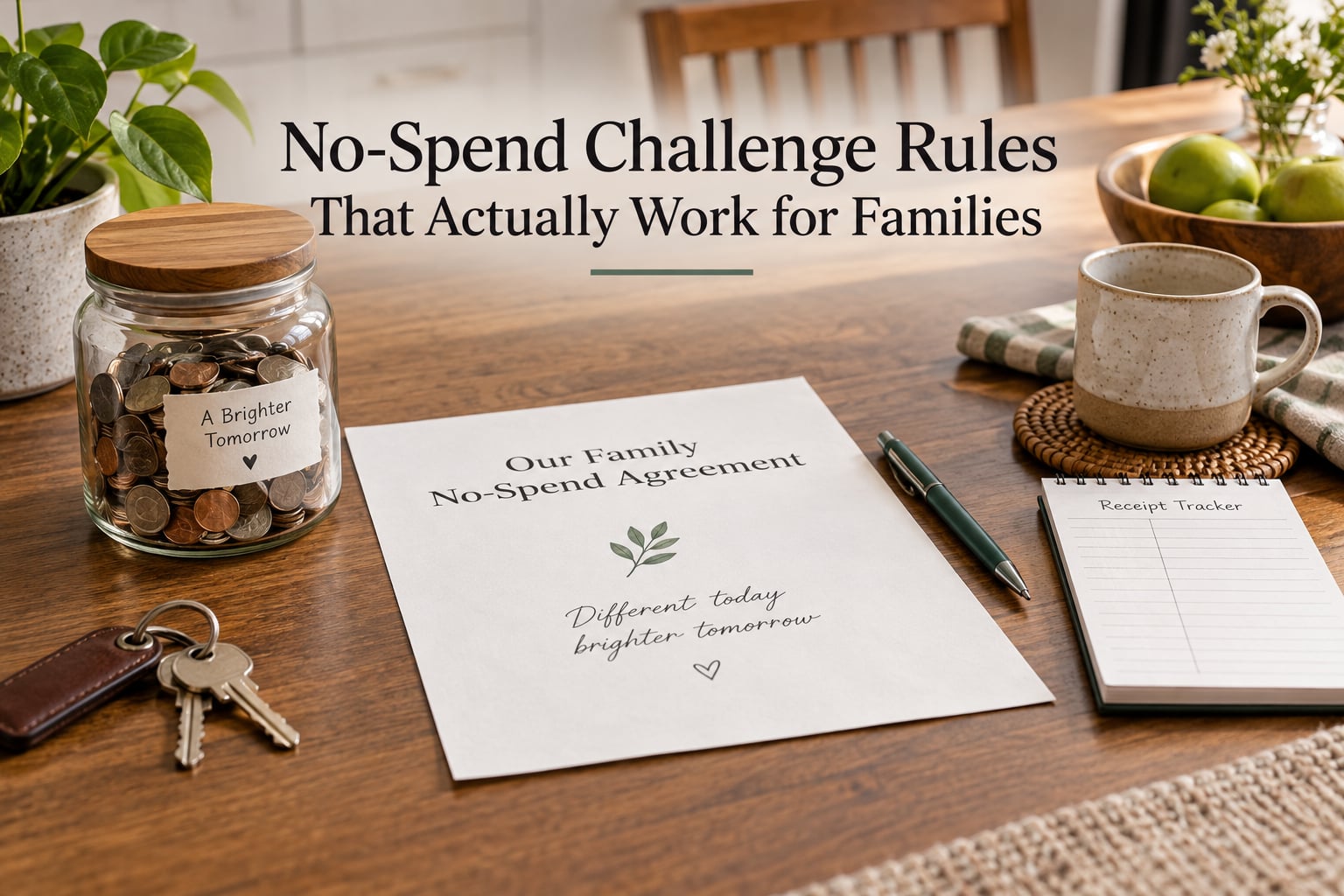
A no-spend challenge is a set period of days when a household keeps paying only essential bills and pauses all discretionary spending. For families, the point is not deprivation. The point is to see, on paper, where the money that leaks out on takeout, coffee runs, impulse clothing, and forgotten subscriptions actually goes, and then send it somewhere that matters.
I have run this in our house more than once, and I have failed at it more than once. What finally worked was less about willpower and more about writing the rules down before we start, because the argument about whether something counts as essential does not happen once at the beginning. It happens at 4pm on a Saturday in the checkout line, every single time, if you have not decided in advance.
So this is the no spend challenge rules list I actually use, the one that survived birthdays, a broken furnace, and a teenager with opinions. It also covers what stays on the books no matter what, how to time the challenge around an Edmonton school year, and how to get the people in your house to sign on instead of quietly sabotaging you at the mall.
Table of Contents
- What Is a No-Spend Challenge?
- The No-Spend Challenge Rules That Actually Work
- Green Light, Red Light: What You Still Pay For
- The Rules Most Families Get Wrong
- How to Set Up a No-Spend Challenge as a Family
- How Long Should a No-Spend Challenge Last?
- How to Get Your Kids on Board
- What to Do When Your Partner Is Not on Board
- How Much Can a Family Realistically Save?
- Free and Low-Cost Things to Do in Edmonton While You Are Not Spending
- Where to Put the Money You Saved
- The Printable Family No-Spend Agreement
- Frequently Asked Questions
- What are the rules of a no spend challenge?
- What counts as essential spending?
- What are considered essentials in a budget?
- What is the difference between essential and non-essential spending?
- How long should a no spend challenge last?
- How do you do a no spend challenge with kids?
- How much can you save in a no spend month?
- Your Turn: Pick a Start Date
What Is a No-Spend Challenge?
A no-spend challenge is a set period, anywhere from a weekend to a full year, during which you spend only on essentials. Essentials are the bills that keep your household running: rent or mortgage, utilities, groceries, medications, insurance, childcare, and the transportation you need to get to work or school.
It is worth separating this from a spending freeze, because the two get blurred constantly. A spending freeze is a blunt pause on everything discretionary, usually triggered by a money shock. A no-spend challenge is deliberate, has a start date, has an end date, and has a written rules list. The freeze is a reaction. The challenge is a decision.
Families usually do not overspend because they need to. They overspend because spending is automatic, and automatic spending is invisible. Thirty days of pausing it makes the invisible visible, which is the only reason it works.
The No-Spend Challenge Rules That Actually Work
These are the rules of a no spend challenge that have held up in our house. Each one is a single clause you can write on a sheet of paper and stick to the fridge.
- Pay for essentials only. Rent, utilities, groceries, medications, insurance, childcare, and work or school transportation stay on the books. Everything else is paused. This is the whole challenge in one sentence.
- Set the savings goal before the first day, not after. People on r/Anticonsumption and r/Frugal report the same thing repeatedly: the rules stick when the money is attached to something visible, not to the vague instruction to save money.
- Write the exceptions list before you start. The absence of an escape hatch is the single most common reason families quit. Decide now what breaks the rules without a debate.
- Use what you own first. New clothes, new kitchen gear, new toys, and new hobby supplies wait until the challenge ends. Shop your home and your closet before any store.
- No new subscriptions, including free trials. A free trial still enters your life, and free trials convert to paid. Nothing new starts during the challenge.
- Freeze the takeout and delivery habit. Plan every meal from what is already in the freezer and pantry for the whole timeframe, or the challenge fails on day four.
- Apply the 24-hour waiting rule to anything over 50 dollars. Write the item and the price in a want list. If it still feels necessary in 24 hours, it leaves the want list with an answer attached.
- Move the money on day one, not on the last day. The moment you can see it sitting in a savings account, the challenge stops feeling like punishment and starts feeling like progress.
- Rig your environment. Unsubscribe from the retail email lists, delete the shopping apps, and keep one card out of your wallet. Decision fatigue is the enemy, not willpower.
- Track what you did not buy. A running total of resisted purchases turns the challenge from a feeling into a number.
- Hold a short family check-in every week. Ten minutes, same time, same spot. It keeps the rules feeling like a team project rather than a punishment imposed on one adult.
- Allow one planned treat per person per week. Full cold turkey on every small comfort is the version of this that nobody finishes. One scheduled coffee or treat keeps the challenge humane.
Rule 12 is the one I would move to the front if I could. A family that allows zero treats will find a reason to quit by the second weekend, and a family that fails is worse off than a family that never tried.
Green Light, Red Light: What You Still Pay For
What counts as essential spending comes down to one test: would this purchase stop the household from functioning next week if you skipped it? If yes, it is a green light. If the household would still be fine, it is a red light for the duration of the challenge.
| Green light: you still pay for | Red light: you pause |
|---|---|
| Rent or mortgage | Clothing and shoes |
| Heat, power, water, internet, phone | Takeout, delivery, restaurant meals |
| Groceries and basic household supplies | Coffee shop runs and drive-throughs |
| Prescriptions, dental, medical | Entertainment and event tickets |
| Home and vehicle insurance | New subscriptions and free trials |
| Childcare and school fees already invoiced | New hobby gear and sports equipment |
| Transport to work and school | Gifts, decor, impulse aisle items |
Some things genuinely stay on the books because you are already committed to them, even though they are not strictly essential. Debt payments and minimum credit card payments, travel you have already booked, memberships inside their paid term, and gifts you have already promised someone all keep running. A challenge that retroactively cancels those is not a challenge, it is a surprise.
What stays on the books is not the same as what is allowed. Already-committed money is not a loophole for new spending. It is just the floor of the challenge.
The Rules Most Families Get Wrong
Most no-spend challenge failures are rule-setting mistakes, not willpower failures. I have watched every one of these happen in our own house or in a friend’s.
- Starting in the wrong month. Do not begin in the month with a birthday, Christmas, back-to-school shopping, or a big family event already on the calendar. Timing errors are the most reliable way to quit in week one.
- Writing rules with zero exceptions. If there is no allowed break, the first surprise expense ends the challenge and feels like a personal failure.
- Setting rules with no goal. A goal of saving more money is not a goal. A goal with a name and a date on it is.
- Going fully cold turkey on small comforts. The all-or-nothing version produces the guilt cycle people describe: you buy something, feel like a failure, then spend more to feel better.
- Doing it alone. If one adult is tracking and the other is not, the tracker is spending energy on a negotiation instead of on the challenge.
- Waiting to start the tracking. If you are not counting what you are not buying, the challenge is just a vibe.
- Trying to save the whole year in one go. The mental leap from broken habits to a full year is the most cited failure mode in frugality forums. A month, repeated, beats a year attempted once.
There are also good reasons not to attempt a no-spend challenge at all. If your income is unstable, if you have no emergency cushion, or if you are in the middle of a medical situation, pausing discretionary spending is not a strategy, it is a risk. Build the buffer first, then run the challenge.
How to Set Up a No-Spend Challenge as a Family
Setup takes about half an hour and it is the part most people skip. Do these five steps in order, in the same sitting, and the challenge runs itself.
1. Decide where the money goes
Choose one destination before you start: a high-interest credit card balance, an emergency fund, a family goal with a date attached, or a registered account such as a TFSA or an RRSP. One destination. Two destinations means neither gets the money.
2. Write the rules on paper
Use the list above and adapt it to your household. The rules need to fit on one page, in your own handwriting, where everyone can see them.
3. Define the exceptions explicitly
Decide what counts as a legitimate exception: a genuine medical need, a school event already invoiced, a birthday gift that is already promised, a breakdown that leaves you no choice. Write them down. Reviewers on r/Frugal say a defined exceptions list removes nearly all the arguments, because the rule stops feeling arbitrary and starts feeling fair.
4. Choose the timeframe and the start date
Pick both now, put them on the page, and tell your household. A start date announced in advance is a commitment. A start date felt out is an idea.
5. Set up accountability and move the money
Set up an automatic transfer for the amount you expect to save, dated to the day the challenge starts. Then book a short weekly check-in with everyone in the house, and find one person outside the household who will ask how it is going.
How Long Should a No-Spend Challenge Last?
How long should a no spend challenge last? It depends on how much disruption your household can absorb and how much saving you need. My recommendation for most families is one month, because a month is long enough to build a habit and short enough to finish.
| Timeframe | Difficulty | Realistic holdback | Best fit for |
|---|---|---|---|
| No-spend weekend | Low | A modest amount, mostly takeout and coffee | Testing the idea before committing |
| No-spend week | Low to medium | One week of paused discretionary spending | Households with young kids and busy weeks |
| No-spend month | Medium | Four weeks of paused discretionary spending | Most families, and the best payoff |
| No-spend year | High | Twelve months, but only if the rules survive | Households that already ran several months well |
Never jump from nothing to a year. Run a month, review it with your household honestly, then run another. Families who succeed with a year almost always did a month first.
How to Get Your Kids on Board
How do you do a no spend challenge with kids? You give them a job, not a restriction. Children handle a shared goal far better than they handle a rule that only applies to them at the worst possible moment, which is a store aisle.
- Preschool and toddler years. Keep the rules adult-owned. A three-year-old cannot skip a birthday cake, so a cake is not a rule break. Tell them there is a special family week, and mean it.
- School age. Give them a want list and a jar. Every time they ask for something and wait instead, they write it down and add a token. At the end of the challenge they decide together what to buy with what they accumulated, and it comes out of the family goal, not out of nowhere.
- Teens. Hand them the real numbers. Show them what the takeout habit costs per month across a year. A teen who sees that figure will usually cut it themselves, and they get the feeling of having negotiated the rules rather than having rules imposed on them.
Allowance is not a rule break. It is the same money coming from a different place, and pulling it mid-challenge reads as punishment. Keep allowance normal and let the challenge affect the adults’ discretionary spending hardest.
Two sentences at the family meeting do most of the work: here is what we are doing and why, and here is the goal we are buying with it. People, kids included, follow rules that have a stated reason far more often than rules that arrive as an instruction.
What to Do When Your Partner Is Not on Board
Split the challenge into a household version and a personal version. Tell your partner what you are doing for your own spending, without asking them to change a single thing they buy. Do not present it as a household rule they are failing to follow.
Keep your own commitments completely out of shared money. Use your own account, your own tracking, your own savings transfer. This removes the accusation of control, which is the fastest way to end an argument you did not need to have.
If your partner does want in, make it a joint project with a shared goal. People report that a shared goal keeps a challenge alive long past the point where willpower runs out. A lone challenge usually dies around day 19, when the novelty wears off.
How Much Can a Family Realistically Save?
How much can a family save in a no spend month? The honest answer is: as much as your last three months of non-essential spending, which is usually far more than families expect. Nobody quantifies this in the guides you will read, so here is a planning method instead of a promise.
Pull your last three months of statements from your bank app. Add up four columns: dining and takeout, coffee and treats, shopping, and subscriptions and memberships. Divide by three. That monthly number is your realistic holdback, because it is your own spending, not a stranger’s estimate.
| Household | Where the paused money usually comes from | Planning approach |
|---|---|---|
| Couple, no kids | Dining, coffee, subscriptions, shopping | Use the three-month average of your own statement columns |
| Family of three | Above, plus school events and kid-driven requests | Same method, plus the school fee calendar |
| Family of four | Above, plus activities, sports, and transportation fuel | Same method, plus one mid-challenge planned treat per person |
| Family of five or more | Above, plus childcare and larger grocery baseline | Same method, expect the first week to be the hardest |
Households with more people have more fixed costs, so the discretionary column is smaller, not absent. The pause still works. It just needs a longer runway and a tighter meal plan.
Free and Low-Cost Things to Do in Edmonton While You Are Not Spending
A no-spend challenge fails when the only alternative to buying something is sitting at home. Fix that before you start, and the rules get much easier.
- Your local public library almost always runs free programming for kids, and membership is free. That covers story time, craft sessions, and the occasional workshop in a cold month.
- City and community recreation centres publish seasonal free and low-cost family activity schedules, including indoor play structures and pool sessions.
- Public markets, parks, and outdoor rinks and trails are free and usually within driving distance of most Edmonton neighbourhoods.
- Free family meal idea exchanges have moved entirely online, and swapping a meal for one you already have in the pantry is genuinely zero dollars.
- Swap rotation for gear your kids have outgrown, with another family, costs nothing and covers the sports and winter clothing categories that would otherwise be the biggest red-light temptation.
Build the list before the challenge starts. People report the same thing from every angle: focusing on free experiences rather than material goods is what makes the rules bearable.
Where to Put the Money You Saved
Decide before day one and automate the transfer so the money is gone before you can miss it.
- High-interest credit card debt first. If you are paying interest on a balance, this is where a month of paused spending has the most impact.
- Emergency fund next. If you have none, a completed challenge gives you a real starting balance instead of an intention.
- A family goal with a date. A trip, a replacement vehicle, a course, or a down payment. Visible goals survive motivation better than abstract savings.
- A TFSA or RRSP contribution if you have room and the horizon fits. A registered contribution made from a month of saved spending is a quiet, permanent win.
One habit worth keeping afterwards: a weekly reset day. Pick one day a week where non-essential spending stops for 24 hours. It costs nothing, keeps the awareness sharp, and stops the month from quietly fading.
The Printable Family No-Spend Agreement
This is the artifact that turned a private experiment into a household project for us. Fill it in together, sign it, and put it somewhere visible. Written in 2026, updated whenever the rules change.
Our Family No-Spend Agreement
We are pausing non-essential spending from [start date] to [end date]. Our goal is [goal], and when the challenge ends that money goes to [destination].
Still on the books: housing, utilities, groceries, medications, insurance, childcare, school fees already invoiced, debt payments, transport to work and school, and anything already booked or promised.
Paused until the end: clothing, dining out, delivery, coffee runs, entertainment, new subscriptions and free trials, new hobby gear, gifts, and impulse purchases of any size.
Our exceptions are: medical needs, genuine emergencies, events already invoiced, and one planned treat per person per week.
Agreed by: [parent one], [parent two], [child one], [child two]. Date: [date].
Then run a weekly check-in with three questions: what did we manage this week, what was harder than expected, and what do we change for next week. Ten minutes is enough. If someone slips up, adjust the rules instead of quitting, because restarting from scratch is how most families end up abandoning the whole idea.
Frequently Asked Questions
What are the rules of a no spend challenge?
The core rules are: pay for essentials only, write your exceptions in advance, use what you own before buying anything new, start no new subscriptions, plan meals from your freezer and pantry, apply a 24-hour waiting rule to purchases over 50 dollars, and move the money you save somewhere visible on day one. Add a goal with a date on it, and hold one planned treat per person per week so the rules stay realistic.
What counts as essential spending?
Essential spending is whatever the household would struggle to function without next week: rent or mortgage, heat, power, water, phone and internet, groceries, prescriptions and medical costs, insurance, childcare, school fees already invoiced, and the transportation needed to get to work or school. Debt payments and travel already booked also stay, because you are committed to them. The test is simple: if skipping it would break the household this week, it is essential.
What are considered essentials in a budget?
Budget essentials fall into a few categories: housing, utilities, groceries and household supplies, transportation, health, insurance, and childcare or school. Everything else is discretionary, which includes dining out, coffee runs, entertainment, clothing, and subscriptions. Families who argue about the list usually have not written it down, so put the categories on paper before the challenge starts and agree on them once.
What is the difference between essential and non-essential spending?
Essential spending keeps your household running and is largely fixed: rent, utilities, groceries, medications, insurance, and transport. Non-essential spending is everything you choose, which is where the pause happens: takeout, coffee, shopping, entertainment, and new subscriptions. The distinction is not about how much something costs. A twenty-dollar coffee is non-essential. A three-dollar bus fare to get to work is essential.
How long should a no spend challenge last?
For most families, one month is the sweet spot. A weekend or a week is good for testing whether the rules work in your household before committing. A year is the hardest version and only makes sense if you have already completed at least one full month successfully. Starting small and repeating beats one long attempt that collapses in week one, and avoid starting in a month with birthdays or back-to-school costs on the calendar.
How do you do a no spend challenge with kids?
Give children a job rather than a restriction. Younger kids keep the rules adult-owned and get a promised family treat to look forward to. School-age kids get a want list and a jar, adding a token every time they wait instead of asking. Teens get the real numbers: what the family takeout habit costs over a full year. Keep allowance normal, and state the goal and the reason out loud at a family meeting.
How much can you save in a no spend month?
The most reliable number is your own. Pull three months of bank statements, total your dining, coffee, shopping, and subscription columns, and divide by three. That monthly figure is what your household realistically holds back, because it is based on how you actually spend. Families are usually surprised by the result, which is the point of doing the calculation before you start.
Your Turn: Pick a Start Date
Pick a no spend challenge rule set tonight, put a start date on it, and tell your household before the day arrives. A challenge without a date is a thought. A challenge with a date, a goal, and a signed agreement on the fridge is a plan.
If you tell me your timeframe and your biggest spending trigger, we can help you build the exception list before you start. That list is the piece most families skip, and it is the piece that decides whether you finish.